


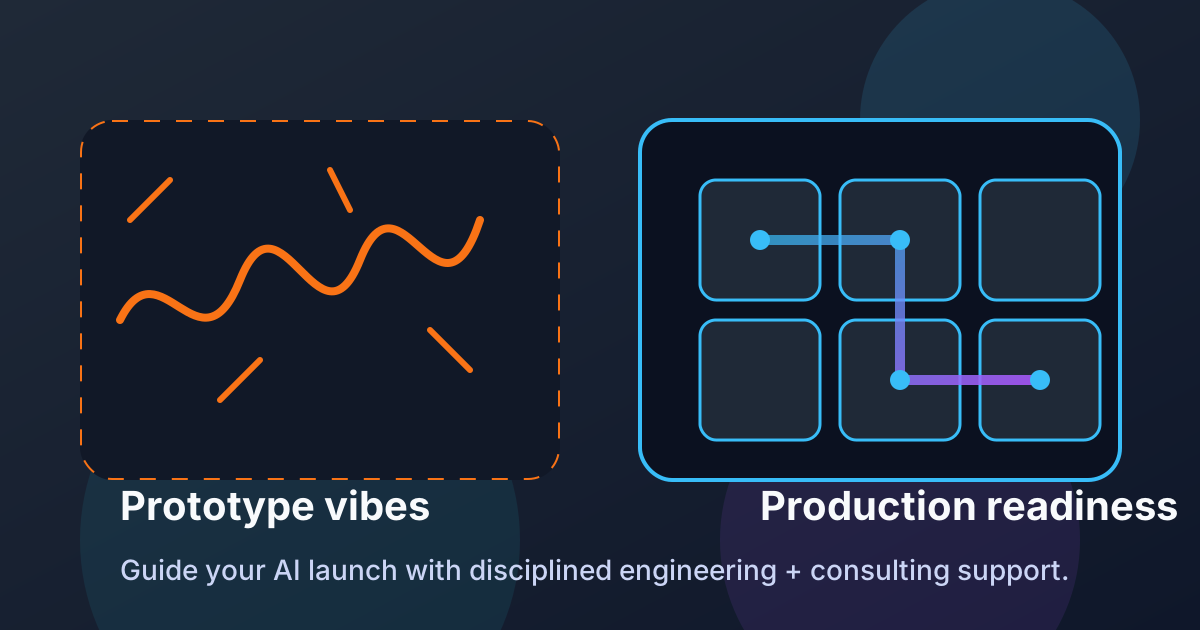
Over the last year I have been called in to rescue more than a few "vibe-coded" AI projects: proofs of concept that worked during a demo but fractured when they reached real users. The problems often sat outside the model, in data dependencies, manual steps, and permissions that the demo never tested.
1. Unstable Foundations Disguised as Momentum
A vibe-coded prototype usually leans on duct-taped scripts, generous manual oversight, and a few lucky prompts. That momentum is deceptive: once traffic spikes or business stakeholders ask for repeatable results, the cracks appear. Inputs drift, models hallucinate, and manual steps become overnight bottlenecks.
How I help: I start with a production readiness audit that inventories every API call, data dependency, and manual workflow. We identify which dependencies and manual steps need attention before launch.
2. Missing Observability and Guardrails
Rapid-fire experiments rarely include telemetry, alerting, or a risk mitigation plan. In production, that translates to teams discovering failures from angry tweets or customer support tickets. Worse, unmonitored AI behavior can lead to compliance violations or brand damage.
How I help: I instrument your pipelines with tracing, evaluation dashboards, and human-in-the-loop workflows. These checks help the team detect changes in behavior and trace failures to the affected step.
3. Fragile Prompting and Data Pipelines
Early prototypes survive on a handful of curated examples and hero prompts. In production, inputs diversify and the model’s behavior becomes inconsistent. Data contracts that were never written down get broken by the first upstream schema change.
How I help: I work with your team to codify prompts, build regression test suites, and validate incoming data. These checks help expose incompatible inputs and changes in model behavior.
4. Overlooked Security and Compliance
It’s easy to forget about secret management, access controls, and auditing when the goal is “just a demo.” Unfortunately regulators, customers, and procurement teams expect full accountability before signing off on an AI product.
How I help: I review role-based access, encrypted storage, and vendor risks with the team. Legal and compliance stakeholders still need to assess whether the proposed controls meet their requirements.
5. Team Burnout and Scope Creep
When the prototype falters, engineers scramble to patch holes while leaders pile on new feature requests. Morale dips, weekends vanish, and suddenly the project misses its launch window.
How I help: I help reset the roadmap around the smallest valuable release. We agree on ownership, review progress, and adjust scope when the work exceeds the team’s capacity.
If your prototype needs a production review, share the workflow and known failures. We can identify what needs to change before real users depend on it.