

Case study
Designing a Commerce Platform Around Capabilities, Not Vendors
Keeping pricing, payments, loyalty, fulfillment, analytics, finance, and operations adaptable as the commerce ecosystem changed
An anonymized architecture case study from commerce platform work that supported 2.19M+ orders and $158.6M+ in revenue since September 2020, showing how capability boundaries, explicit vendor adapters, and recoverable integrations preserved business flexibility.
- $158.6M+
- commerce revenue supported since September 2020
- 2.19M+
- orders supported across the same public reporting period
- 100+
- retail locations participating in unified commerce operations
These verified public career metrics establish the operating scale of the broader commerce work. They are not presented as revenue caused by one service, subsystem, or architecture decision.
Problem
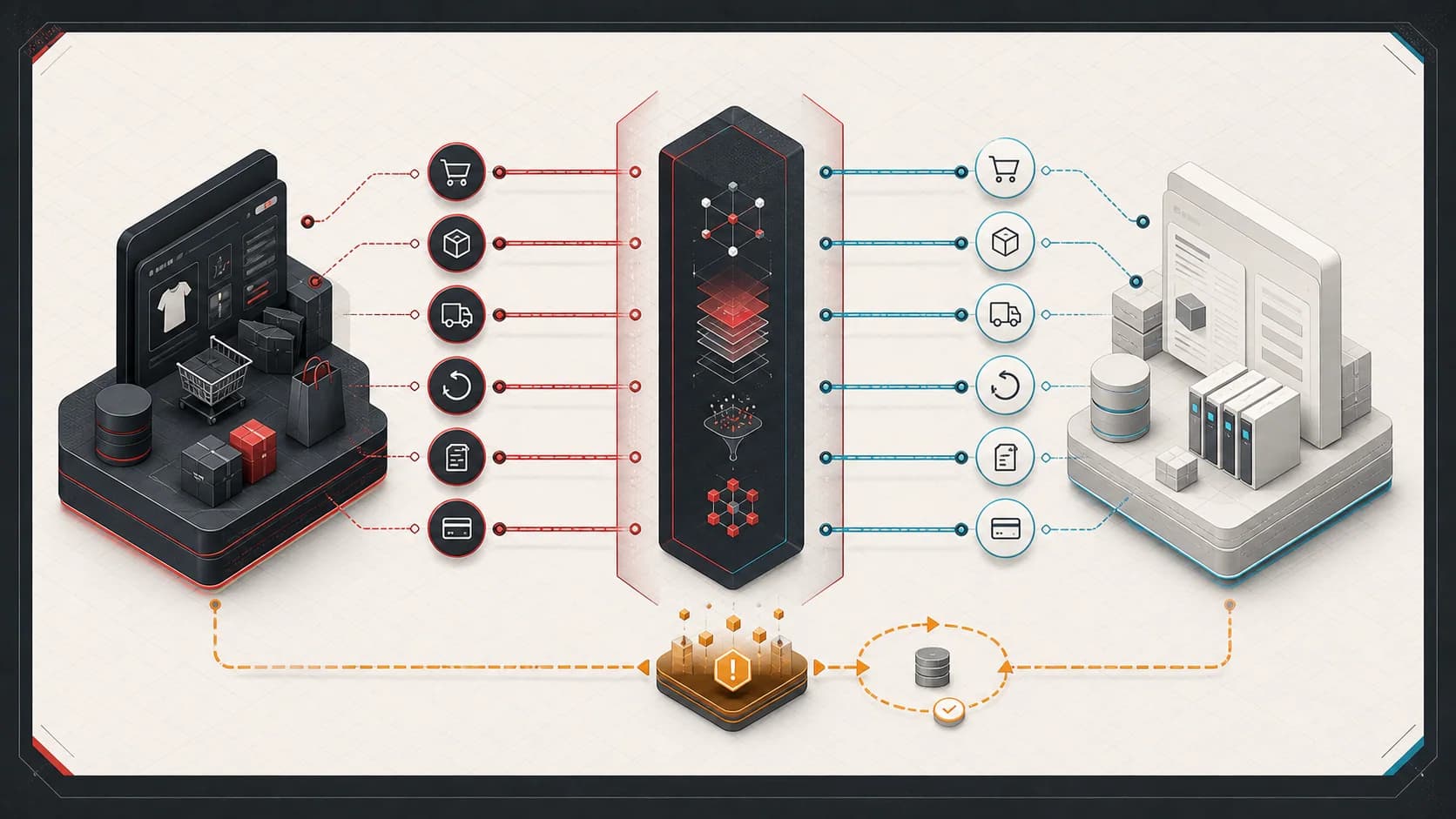
A business-critical commerce ecosystem had to support changing channels, vendors, operating rules, and cross-functional needs without making every change a rewrite of checkout, order, customer, fulfillment, or financial workflows. The central architecture problem was not choosing one commerce platform. It was preserving durable business capabilities while vendor models, integration contracts, and organizational priorities continued to change.
Business and Operating Constraints
- Revenue-critical order and payment workflows could not be treated as experimental integration paths.
- Pricing, payments, loyalty, fulfillment, analytics, finance, and operations had different ownership, data, timing, and failure requirements.
- Commerce vendors, payment providers, fulfillment systems, and enterprise platforms represented the same business concepts differently.
- Finance and operations needed traceability and reconciliation, not only confirmation that an API request succeeded.
- The platform had to evolve incrementally while existing channels and operational workflows continued running.
- The architecture needed to remain understandable to future engineers instead of depending on one person who remembered every vendor exception.
Alternatives Considered
Put business behavior inside the commerce vendor
This can accelerate standard storefront work, but pricing, loyalty, payment, fulfillment, and financial rules become constrained by one vendor’s extension model. It was appropriate for vendor-native behavior, not for capabilities the business expected to outlive the vendor.
Connect every system directly to every other system
Point-to-point integrations can solve the first flow quickly, but ownership, identifiers, status mapping, retries, and exception handling become inconsistent as channels and systems multiply. The short-term simplicity turns into operational coupling.
Replace the ecosystem through a big-bang rewrite
A rewrite could produce a cleaner target architecture on paper, but it would combine platform replacement, data movement, integration change, and business rollout into one risk event. Incremental capability replacement preserved more reversibility.
Build a generalized commerce framework before the need was proven
A highly configurable platform can become another product the team must operate. The safer approach was to create explicit seams around recurring variation and keep ordinary code where the business rules were still changing shape.
Architecture Decisions
1. Model durable business capabilities first
The platform was organized around business responsibilities such as pricing, payments, loyalty, orders, fulfillment, and financial reporting. Vendor APIs and storage models supported those capabilities but did not define their public business contracts.
2. Establish explicit ownership and source-of-truth rules
Each important record, identifier, status, and lifecycle event needed a clear owner. This reduced ambiguous synchronization and gave finance, operations, and engineering a shared answer when commerce and enterprise systems disagreed.
3. Isolate vendor semantics behind deliberate adapters
Commerce, payment, fulfillment, and enterprise providers kept their proprietary requests, responses, identifiers, and edge cases at integration boundaries. Business-facing workflows consumed stable contracts and translated into provider behavior only at the edge.
4. Treat integration recovery as part of the product
Critical flows needed idempotent handling, bounded retries, audit evidence, reconciliation, and a path for operators to resolve exceptions. A successful API response was not enough if downstream systems could still disagree about an order, payment, refund, or fulfillment.
5. Use configuration for bounded business variation
Rules that changed frequently and had understood boundaries could move into governed configuration. Rules that were still evolving remained explicit code until the variation was real enough to justify another abstraction.
6. Sequence change through capability-sized releases
New vendors, channels, and platform behavior could be introduced behind existing business contracts and proven incrementally. This kept migrations, reconciliation, rollout, and rollback separate from the decision to improve a capability.
7. Make operational visibility cross-functional
The platform needed evidence that finance, fulfillment, analytics, support, and engineering could use. Reports, logs, identifiers, and exception workflows were designed around business questions rather than isolated service health.
Tradeoffs Accepted
- Capability boundaries add contracts, mapping, tests, and operational metadata that a direct vendor call does not require.
- Not every provider deserves a generalized abstraction; some integrations remain deliberately specific until replacement or variation becomes plausible.
- Stable business contracts require governance so they do not become a generic dumping ground for every vendor feature.
- Retries, reconciliation, and exception workflows increase implementation effort, but omitting them transfers that cost to finance, operations, support, and incident response.
- Incremental evolution preserves reversibility but temporarily requires old and new paths to coexist, with explicit criteria for retiring compatibility behavior.
Outcome
The commerce platform supported sustained order and revenue operations at the verified scale shown above while serving unified commerce needs across channels and operating teams. The durable result was not one permanent vendor choice. It was an architecture in which core commerce capabilities, integration ownership, and operational recovery could evolve without forcing the business to rebuild every surrounding workflow at once.
Lessons So Far
- Commerce architecture is primarily an ownership and change-management problem, not a storefront framework decision.
- A vendor boundary creates leverage only when identifiers, reconciliation, operational tools, and failure behavior are included.
- Capabilities should be isolated where change is recurring and consequential; abstracting every implementation detail only creates another platform to maintain.
- Finance and operations are part of the architecture because they determine whether distributed commerce state can be trusted.
- The value of adaptable architecture appears over multiple vendor, channel, and requirement changes—not in the first implementation alone.
Have a Similar Platform Challenge?
If commerce, ERP, payment, fulfillment, or reporting systems are constraining how the business can change, I can help map the ownership gaps, integration risks, and smallest responsible path forward.
Commerce Integration Audit
Request an Integration Audit