


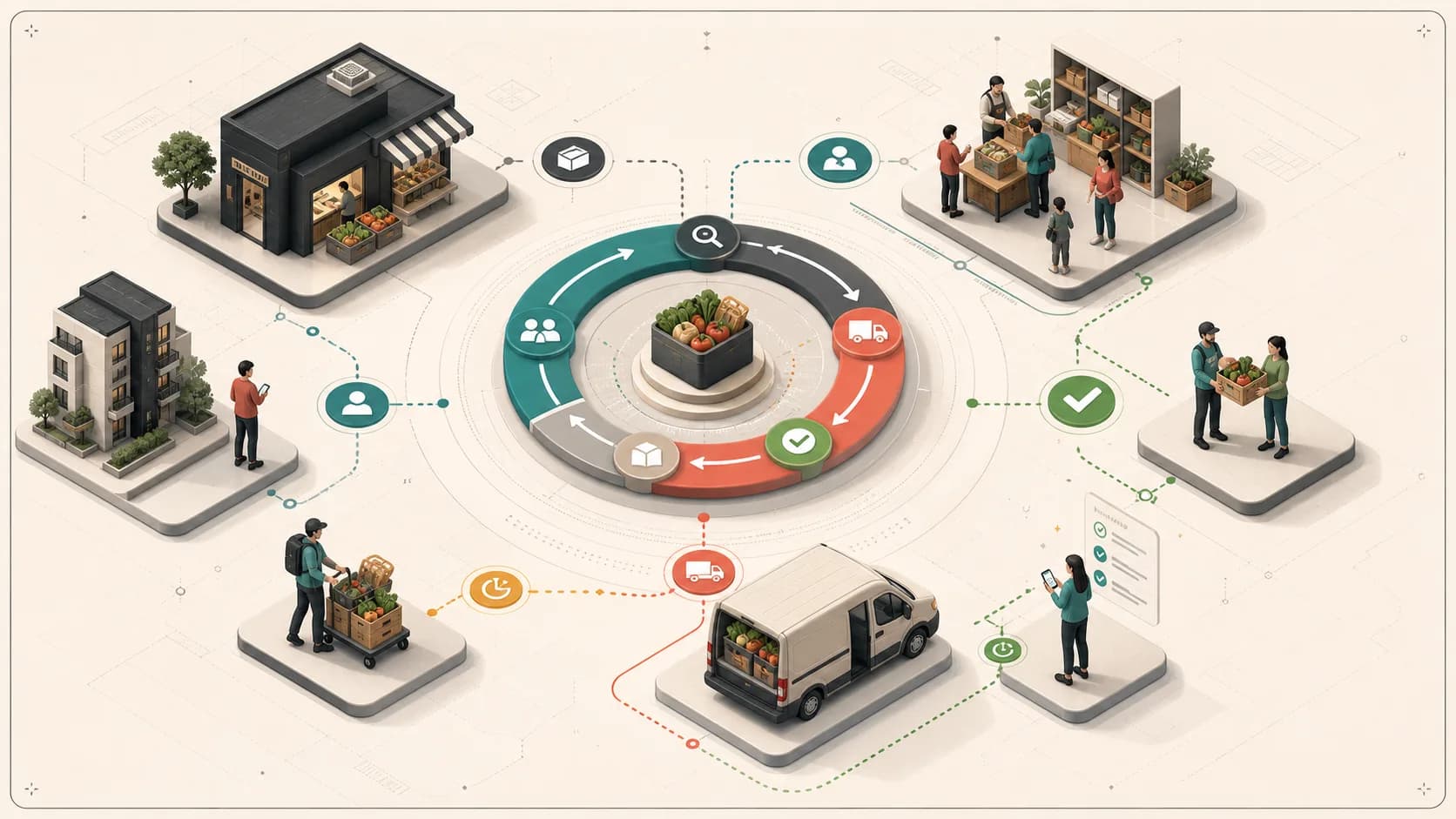
Surplus-food redistribution is not a simple marketplace problem. A useful product has to coordinate people offering food, organizations receiving it, volunteers or logistics participants moving it, and community partners supporting the process.
Tlaloc Harvest was designed as a launch-ready product foundation for that multi-sided workflow. The objective was not to claim impact before usage data existed. It was to give an early-stage sustainability effort a coherent operating model that could grow without overbuilding the first release.
The coordination problem
Food availability is time-sensitive and location-dependent. A listing only has value if the right participant can discover it, understand the pickup constraints, and complete the handoff while the food remains usable.
The product therefore needs to account for several concerns at once:
- Different participant roles and responsibilities
- Location and service-area boundaries
- Pickup timing and coordination
- Trust between residents, businesses, volunteers, and partners
- A clear lifecycle from available surplus to completed redistribution
- Future reporting without presenting estimates as measured impact
Treating every participant as a generic marketplace user would hide the operational differences that make the workflow work.
Model the workflow before adding incentives
The early architecture centers the core redistribution lifecycle: describe available surplus, connect it to an appropriate participant, coordinate the handoff, and record the result.
Features such as rewards, partner programs, route optimization, or carbon-impact reporting may become useful as the operating model matures. They should follow validated behavior and reliable source data rather than lead the product definition.
This sequencing keeps the initial system understandable and avoids making sustainability claims the product cannot yet support.
Design for multiple participant types
Residents, businesses, volunteers, coordinators, and community partners do not need identical interfaces. They share a workflow but have different decisions to make.
The product foundation separates those concerns while preserving a common model for:
- Surplus-food availability
- Participant and partner context
- Location-aware coordination
- Pickup and redistribution status
- Community participation records
That common model provides room for new partner programs or reporting requirements without forcing the core workflow into a single buyer-and-seller abstraction.
Keep impact claims tied to evidence
A sustainability platform can easily drift into broad claims about waste reduction, emissions, or community impact. Those outcomes require trustworthy operational data and agreed measurement rules.
The safer architecture is to record concrete events first: what was offered, whether it was matched, whether pickup occurred, and which participants completed the workflow. Higher-level impact reporting can then be built from evidence instead of marketing assumptions.
Outcome so far
The result is a shipped, launch-ready web application foundation for a complex community and logistics problem. Public adoption and impact metrics are not available, so the defensible outcome is the product model and working platform surface—not claims of eliminated waste, optimized logistics, or global scale.
The Tlaloc Harvest case study documents the problem, constraints, product decisions, and current outcome in more detail.
The broader architectural lesson is straightforward: multi-sided platforms should be organized around the real coordination lifecycle. Incentives, reporting, and optimization become valuable only after that lifecycle is clear enough to operate and measure.