


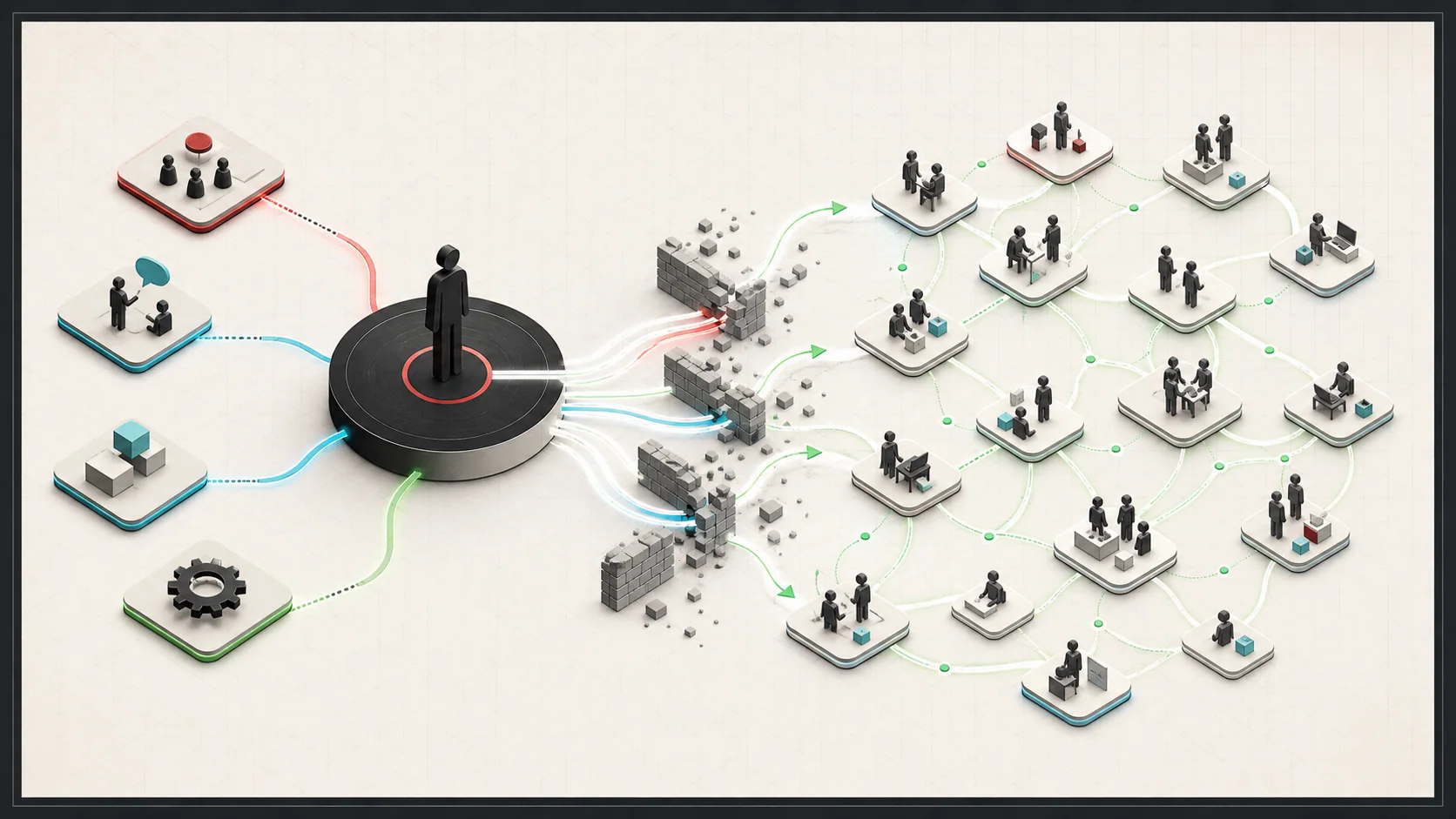
Software leaders often get pulled back into individual contributor work because it feels concrete and urgent. Fixing a bug, reviewing a pull request, or jumping into an architecture problem gives an immediate sense of progress.
The problem is that leadership work usually matters most when it is indirect.
That is one of the most useful ideas in Andy Grove's High Output Management. A manager's output is not measured by how many things the manager personally finishes. It is measured by what the team can do because the manager made the team more effective.
For software leaders, that framing still holds up. If your team ships more clearly, recovers from problems faster, hires better, and wastes less effort because of how you lead, that is output. If you stay busy but the team stays confused, your activity is not leverage.
A manager's output is the output of the team
This sounds obvious until a leader starts having a bad week.
When pressure rises, many managers fall back into doing visible work themselves. They rewrite designs, take over incidents, make every decision personally, or become the default escalation path for everything. Sometimes that is necessary for a short period. As a system, it does not scale.
A software organization gets stronger when leadership increases the capability of the team rather than the dependence of the team.
That means asking different questions:
- Are priorities clear enough that people can move without waiting for me?
- Are decisions getting made at the right level?
- Does the team understand what good output looks like?
- Are recurring problems being fixed at the system level?
- Are the strongest people multiplying others or just carrying too much?
These are leverage questions. They produce more value than simply adding another set of hands to the codebase.
Leverage is not management theater
Managers sometimes hear the word leverage and turn it into ceremony.
More meetings. More dashboards. More status reporting. More one-on-ones with no clear purpose. More process that signals leadership without improving output.
That is not leverage. That is management theater.
Real leverage comes from actions that materially change how the team operates. In software organizations, the biggest leverage points are usually:
- Decision quality
- Hiring
- Onboarding
- Feedback
- Prioritization
- Process design
- Cross-team coordination
A clear decision can remove days of hesitation. A strong hire can change a team's capacity for years. Better onboarding can reduce the time it takes a new engineer to become useful. A direct feedback conversation can stop a weak pattern from becoming a team norm.
These are not glamorous actions. They are high-output actions.
Vague decisions create drag
One of the easiest ways to spot weak leadership is to watch how decisions happen.
Many software organizations look collaborative on the surface but are actually indecisive underneath. A problem gets discussed by several smart people. Everyone raises reasonable concerns. Nobody wants to make the wrong call. The meeting ends with more analysis, more options, and no owner.
That feels careful. In practice, it creates drag.
Teams lose momentum when they cannot tell the difference between exploration and avoidance. Engineers start hedging. Work gets partially started in multiple directions. Architecture discussions keep reopening. Product and engineering burn time waiting for someone to decide what the decision actually is.
Leaders create leverage by making decision paths explicit:
- What decision is being made?
- Who owns it?
- What input is needed?
- When does the debate end?
- What tradeoff are we accepting?
That does not mean every decision should be top-down. It means every important decision should stop floating.
Bottlenecks and process debt are leadership problems
Software teams often talk about technical debt. They should also talk about process debt.
Process debt shows up when work slows for reasons everyone recognizes but nobody fixes:
- Pull requests wait too long for review
- Priorities shift without clear communication
- Dependencies between teams are negotiated ad hoc every sprint
- Incidents reveal the same ownership confusion again and again
- Roadmaps exist, but nobody trusts them
These are not random annoyances. They are output constraints.
Grove's factory language can feel rigid in modern software contexts, but the bottleneck idea still matters. If a team repeatedly gets stuck in the same place, leadership should treat that as a design problem.
You do not solve every bottleneck by adding more people. Often you solve it by making expectations clearer, reducing approvals, assigning ownership, improving handoffs, or removing work that should never have existed in the first place.
A surprising amount of leadership value comes from noticing what keeps slowing everyone down and refusing to normalize it.
Meetings, hiring, and onboarding are force multipliers
Some leadership work looks administrative until you measure its downstream effect.
Meetings are a good example. Most complaints about meetings are really complaints about bad meeting design. A meeting that clarifies priorities, resolves a cross-functional dependency, or forces a decision can save far more time than it consumes. A meeting without a decision, owner, or purpose is just a tax.
Hiring is another leverage point. A weak hire creates management load, slows peers, and lowers trust in the system. A strong hire, placed well and onboarded properly, increases the output of the surrounding team.
Onboarding deserves more respect than it usually gets. If every new engineer has to rediscover how the system works, who owns what, and how decisions happen, leadership has accepted avoidable waste as a norm.
Leverage often looks like building reusable clarity.
What software leaders should do differently
If you want to apply Grove's idea well, start by looking at where your time changes team behavior.
Good questions for a software or organizational leader include:
- Which recurring confusion can I eliminate this month?
- Which team bottleneck is actually a leadership failure?
- Where am I still acting as a heroic contributor instead of building capacity?
- Which meetings create decisions, and which ones only create motion?
- What would make this team less dependent on escalation through me?
The goal is not to become abstract or detached from the work. The goal is to increase the team's output without turning yourself into the permanent workaround.
That is what makes management leverage so useful as a concept. It shifts the job away from visible busyness and toward system improvement.
For software leaders, that is still the right direction. The teams that scale best are usually not led by the busiest person in the room. They are led by the person who keeps making the room work better.