


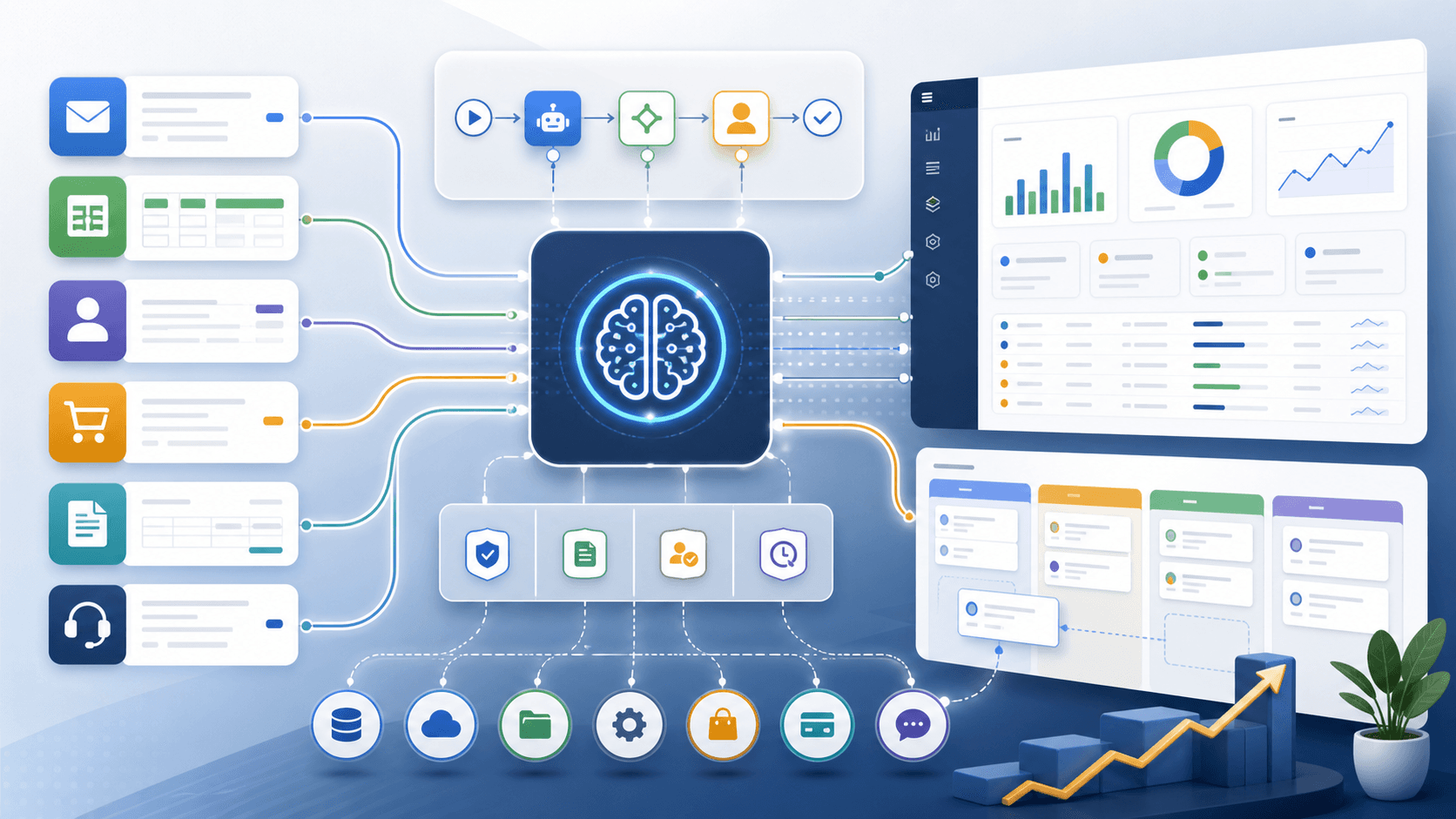
AI workflow automation is one of the most practical ways for small and mid-sized businesses to save time, reduce errors, and scale operations without adding unnecessary headcount. The real opportunity is not replacing people. It is removing the repetitive, manual, copy-and-paste work that keeps good people stuck in the weeds.
If your team spends hours moving data between emails, spreadsheets, CRMs, ERPs, accounting tools, project management systems, or e-commerce platforms, there is a strong chance AI workflow automation can help.
You do not need to be a Fortune 500 company to benefit from it. Modern AI tools, APIs, cloud platforms, and custom software make automation more accessible than ever for growing businesses.
The challenge is knowing where to start.
This guide breaks down what AI workflow automation is, where it works best, where it can go wrong, and how small and mid-sized businesses can use it wisely. For a shorter starting point, see AI workflow automation for small businesses: where to start.
What is AI workflow automation?
AI workflow automation combines artificial intelligence with business process automation. Instead of only following simple rules like "if this happens, then do that," AI-powered workflows can understand text, classify information, summarize documents, extract data, make recommendations, and route tasks based on context.
Traditional automation is great for predictable tasks. For example:
- Sending an invoice after an order is placed
- Moving a lead from a form into a CRM
- Notifying a team when a ticket is created
- Updating inventory after a sale
AI workflow automation goes a step further. It can help with messy, unstructured, human-style information such as emails, PDFs, chat messages, voice notes, product descriptions, support tickets, and contracts.
For example, an AI workflow can read a customer email, determine whether it is a quote request, extract the products mentioned, check inventory, create a draft order, and send the request to a human for approval.
That is the real value: AI handles the heavy lifting, while people stay in control of important decisions.
Why AI workflow automation matters for SMBs
Small and mid-sized businesses often run lean. One person may manage sales operations, customer support, reporting, vendor communication, and internal admin tasks all at once. That works for a while, but as volume grows, manual processes become fragile.
A few common signs include:
- Orders are delayed because staff must re-enter information by hand
- Customer emails sit unanswered during busy periods
- Reports take hours to prepare every week
- Leads fall through the cracks
- Team members rely on one "spreadsheet wizard"
- Different departments use different systems that do not talk to each other
- Errors increase when business volume rises
AI workflow automation helps by turning repeatable business steps into reliable systems. It can speed up response times, reduce manual data entry, and give team members more time to focus on customers, strategy, and revenue.
Research from McKinsey has estimated that generative AI and related automation technologies could create major productivity gains across many business functions, especially when companies redesign workflows instead of simply adding AI tools on top of old processes. You can read their overview here: McKinsey: the economic potential of generative AI.
AI workflow automation vs. regular automation
It is helpful to separate regular automation from AI workflow automation.
| Type | Best For | Example |
|---|---|---|
| Traditional automation | Clear rules and structured data | Send a Slack alert when a form is submitted |
| AI workflow automation | Unstructured information and judgment-like tasks | Read a customer email and classify it as a quote request |
| Custom software automation | Business-specific workflows that need control and integration | Create an order in a custom ERP after AI extracts data from an email |
Traditional automation is still valuable. In fact, many successful AI workflows use both. AI may interpret the information, while traditional automation handles the predictable next steps.
A strong system might look like this:
- AI reads a message.
- AI extracts key details.
- Business rules validate the details.
- Software routes the task.
- A human approves exceptions.
- The system updates the correct tools.
That blend is usually safer and more useful than letting AI act alone.
Common AI workflow automation use cases
AI workflow automation can support almost every department, but it works best when the task is repetitive, high-volume, and tied to clear business value.
Sales and lead management
Sales teams often lose time qualifying leads, updating CRM records, writing follow-up emails, and sorting inbound inquiries.
AI workflows can:
- Score leads based on form responses
- Summarize sales calls
- Draft follow-up emails
- Route leads to the right salesperson
- Enrich CRM records
- Identify urgent opportunities from inbound messages
For an SMB, even a simple lead-routing workflow can improve response speed and help prevent missed revenue.
Customer support
Support teams deal with repeated questions, ticket routing, refund requests, product issues, and account updates.
AI workflows can:
- Classify support tickets
- Suggest replies
- Summarize long customer conversations
- Detect unhappy customers
- Route urgent issues to managers
- Create help desk tickets from emails or chat messages
The goal is not to make customers feel like they are talking to a robot. The goal is to help support staff respond faster and with better context.
Operations and admin
Operations teams are often where automation pays off fastest. These teams handle the behind-the-scenes work that keeps the business running.
AI workflows can:
- Extract data from PDFs
- Process vendor emails
- Update spreadsheets or databases
- Generate weekly reports
- Reconcile records between systems
- Monitor inboxes for important requests
For many companies, this is where the first automation project should begin.
Finance and accounting
Finance workflows need accuracy, control, and auditability. AI can help, but it should be paired with strong validation and approval steps.
Useful examples include:
- Invoice data extraction
- Expense categorization
- Payment reminder drafts
- Purchase order matching
- Report generation
- Anomaly detection
A human should still review sensitive financial actions, especially payments, refunds, and account changes.
E-commerce and order processing
E-commerce companies often receive order requests through more than one channel. Customers may order through a website, email, phone, chat, or marketplace.
AI workflows can:
- Convert email inquiries into draft orders
- Extract product names and quantities
- Check inventory
- Create customer records
- Send order confirmations
- Flag unusual requests for review
This is especially useful for businesses that handle custom orders, B2B orders, wholesale requests, or quote-based sales. For a deeper example, see how email-to-order automation actually works.
Best processes to automate first
The best first automation project is not always the flashiest one. It is usually the one with clear pain, clear rules, and clear ROI.
Look for workflows that are:
- Repeated daily or weekly
- Time-consuming
- Easy to describe step by step
- Prone to manual errors
- Connected to revenue, cost, or customer experience
- Currently handled through email, spreadsheets, or copy-and-paste work
Good first projects include:
| Workflow | Why It Works Well |
|---|---|
| Email triage | High volume and easy to classify |
| Document data extraction | Saves manual entry time |
| CRM updates | Reduces sales admin burden |
| Quote request routing | Improves response time |
| Weekly reporting | Saves recurring staff hours |
| Support ticket classification | Speeds up customer service |
Avoid starting with a workflow that has too many exceptions, unclear ownership, or major legal and financial risk. Start small, prove value, then expand.
Tools used in AI workflow automation
There is no single best AI automation tool. The right stack depends on your systems, budget, security needs, and workflow complexity.
No-code and low-code automation tools
These tools are useful for quick wins and simple integrations.
Examples include:
- Zapier
- Make
- n8n
- Airtable
- Microsoft Power Automate
They are often a great starting point, especially when the workflow is simple and the data does not need heavy customization.
AI models and APIs
AI models can summarize text, extract fields, classify messages, translate content, and generate drafts. Many businesses connect AI models to existing systems through APIs.
Common AI-powered tasks include:
- Text classification
- Natural language understanding
- Document parsing
- Data extraction
- Content generation
- Semantic search
Business system integrations
Most useful automation happens between tools your business already uses.
Examples include:
- Shopify
- WooCommerce
- HubSpot
- Salesforce
- QuickBooks
- NetSuite
- Google Workspace
- Microsoft 365
- Custom ERPs
- Internal databases
Custom software
Custom software becomes valuable when your workflow is unique, complex, security-sensitive, or central to your business.
You may need custom software if:
- Off-the-shelf tools cannot handle your business rules
- You need deep ERP or CRM integration
- You need a custom approval process
- You need better reporting and audit trails
- You process sensitive or regulated data
- You want to own the workflow instead of renting it from many tools
This is the kind of situation where AI workflow automation consulting can help turn a rough process into controlled operational software.
How to build an AI workflow automation strategy
A smart automation strategy starts with business goals, not tools.
1. Map the current workflow
Before automating anything, document how the process works today.
Ask:
- Where does the work begin?
- Who touches it?
- What systems are involved?
- What decisions are made?
- What causes delays?
- Where do errors happen?
- What does "done" mean?
A simple process map can reveal waste quickly.
2. Estimate the cost of manual work
Calculate how much the current process costs.
For example:
- 3 employees spend 5 hours per week on manual data entry
- Average loaded labor cost is $40 per hour
- Weekly cost is 3 x 5 x 600
- Annual cost is about $31,200
That does not include errors, delays, lost sales, or unhappy customers. Once you understand the cost, it is easier to decide whether automation is worth it.
3. Choose one workflow
Do not try to automate the whole company at once. Choose one workflow with strong ROI and manageable risk.
A good first workflow should be narrow enough to launch quickly but important enough to matter.
4. Design human approval points
AI is powerful, but it should not always make final decisions.
Use human approval when:
- Money moves
- Customer records change
- Legal terms are involved
- Inventory is limited
- Confidence is low
- The request is unusual
- The action could damage customer trust
Human-in-the-loop automation gives you speed without losing control.
5. Measure results
Track the impact before and after automation.
Useful metrics include:
- Time saved
- Error rate
- Response time
- Cost per task
- Number of tasks processed
- Customer satisfaction
- Revenue recovered
- Employee workload reduction
Without measurement, automation becomes guesswork.
Security and risk considerations
AI workflow automation must be designed carefully, especially when it touches customer data, financial information, private documents, or internal systems.
The National Institute of Standards and Technology provides an AI Risk Management Framework that encourages organizations to govern, map, measure, and manage AI-related risks. It is a useful reference for companies that want to adopt AI responsibly. You can review it here: NIST AI Risk Management Framework.
Important safeguards include:
- Role-based access control
- Data encryption
- Audit logs
- Human approvals
- Input validation
- Vendor review
- Clear retention policies
- Monitoring for incorrect outputs
- Separation between draft actions and final actions
AI should not be treated as magic. It should be treated like any other business system: useful, monitored, and controlled. For architecture patterns around data access and tool permissions, see how to build a safe AI agent around business data.
Common AI workflow automation mistakes
AI automation can create real value, but only when implemented thoughtfully.
Automating a broken process
If the current process is confusing, automation may only make the confusion happen faster. Clean up the workflow first.
Starting too big
Large automation projects often fail because they try to solve too much at once. Start with one workflow, one team, and one measurable outcome.
Ignoring edge cases
Every business has exceptions. A good workflow knows when to stop and ask for human help.
Trusting AI without validation
AI can misunderstand instructions, extract the wrong data, or generate confident but incorrect answers. Use validation rules, confidence scoring, and review steps.
Choosing tools before defining the problem
A tool cannot fix an unclear goal. Start with the business problem, then choose the technology.
How to calculate ROI for AI workflow automation
ROI does not need to be complicated. Start with the value of time saved, then add other benefits.
Basic ROI formula
Annual Savings = Hours Saved Per Month x Hourly Cost x 12
ROI = (Annual Savings - Project Cost) / Project Cost
Example
Imagine a company spends 80 hours per month processing quote requests manually. The average loaded labor cost is $45 per hour.
80 hours x $45 x 12 = $43,200 annual labor cost
If an AI workflow cuts that work by 60%, the annual labor savings are:
$43,200 x 60% = $25,920
If the automation project costs $15,000, the first-year labor-only ROI is positive. Add faster response times, fewer errors, and improved customer experience, and the real value may be higher.
AI agents vs. AI workflow automation
AI agents are getting a lot of attention. An AI agent can plan tasks, use tools, and take actions across systems. That sounds exciting, but for many SMBs, structured workflow automation is the better starting point.
AI agents are useful when:
- Tasks require flexible reasoning
- The system needs to choose between tools
- The workflow changes based on context
- There are many possible paths
Structured AI workflows are better when:
- The process is repeatable
- Accuracy matters
- You need approval steps
- You need audit logs
- You want predictable behavior
In practice, the best solution may use both. An AI agent can help interpret a request, while a structured workflow controls what happens next.
When SMBs should use custom AI automation
No-code tools are great until they are not. As workflows become more important, businesses often need more control.
Custom AI automation makes sense when:
- The workflow is core to your business
- You need custom business logic
- You have multiple systems to connect
- You need better security
- You need audit trails and reporting
- You are hitting limits with no-code tools
- You want a better user experience for your team
For example, a company may start by using Zapier to move form submissions into a spreadsheet. Later, it may need a custom dashboard, AI document extraction, approval queues, ERP integration, and detailed reporting. At that point, custom software can be a smarter long-term investment.
A practical implementation roadmap
Here is a simple roadmap small and mid-sized businesses can follow.
Phase 1: Discover
List the workflows that waste time or create errors. Interview the people who do the work every day. They usually know exactly where the bottlenecks are.
Phase 2: Prioritize
Score each workflow by effort, risk, and business value. Pick the one with the best mix of low complexity and high impact.
Phase 3: Prototype
Build a small version of the workflow. Use real examples, but keep humans involved. Test whether AI can classify, extract, or summarize information accurately enough.
Phase 4: Validate
Compare AI output with human output. Track errors, missing fields, false positives, and confusing edge cases.
Phase 5: Integrate
Connect the workflow to the systems your business already uses. This may include email, CRM, ERP, spreadsheets, databases, or e-commerce platforms.
Phase 6: Monitor and improve
Automation is not "set it and forget it." Monitor results, review failures, update prompts or rules, and improve the workflow over time.
Example: email-to-order automation
A common SMB use case is email-to-order automation.
The old process looks like this:
- Customer sends an order request by email.
- Employee reads the email.
- Employee extracts product names, quantities, shipping details, and customer information.
- Employee checks inventory.
- Employee creates an order manually.
- Employee sends a confirmation.
The automated version looks like this:
- AI reads incoming emails.
- AI classifies order-related messages.
- AI extracts order details.
- Business rules validate the data.
- Inventory and pricing are checked.
- A draft order is created.
- A human approves exceptions.
- The customer receives a confirmation.
This workflow can save hours per week while reducing mistakes. More importantly, it gives the business a repeatable process that can scale as order volume grows.
AI workflow automation checklist
Use this checklist before launching your first project.
| Question | Why It Matters |
|---|---|
| Is the workflow repeated often? | Repetition creates ROI |
| Is the process clearly documented? | AI needs structure |
| Are the inputs available digitally? | Email, PDFs, forms, and databases work well |
| Are the success criteria clear? | You need a way to measure results |
| Are there risky actions? | Add human approval |
| Can the workflow be tested with past examples? | Historical data helps validation |
| Are integrations available? | APIs reduce manual work |
| Who owns the process? | Every automation needs an owner |
Frequently asked questions about AI workflow automation
What is AI workflow automation?
AI workflow automation uses artificial intelligence to complete or assist with business processes. It can read emails, classify requests, extract data, summarize information, generate drafts, and route work between systems.
Is AI workflow automation only for large companies?
No. Small and mid-sized businesses can benefit because they often have lean teams and many manual processes. Starting with one practical workflow is usually enough to show value.
What is the best first workflow to automate?
The best first workflow is repetitive, time-consuming, and easy to measure. Email triage, document data extraction, CRM updates, quote routing, and weekly reporting are strong starting points.
Will AI replace employees?
In most SMB use cases, AI workflow automation supports employees rather than replaces them. It removes repetitive work so people can focus on judgment, service, sales, and problem-solving.
How much does AI workflow automation cost?
Costs vary depending on complexity. A simple no-code workflow may cost very little to test, while a custom integrated system may require a larger investment. The right question is whether the savings, speed, and accuracy gains justify the cost.
Is AI workflow automation safe?
It can be safe when designed with controls. Businesses should use access permissions, audit logs, validation rules, human approvals, and clear data policies. Sensitive workflows need extra care.
Do I need custom software for AI automation?
Not always. No-code tools are useful for simple workflows. Custom software is better when the workflow is complex, business-critical, security-sensitive, or deeply connected to internal systems.
How long does it take to see results?
Many businesses can see value from a focused pilot quickly, especially when the workflow is narrow and well understood. Bigger results come from improving and expanding automation over time.
Start small, build smart, and automate what matters
AI workflow automation is not about chasing hype. It is about finding the repetitive work that slows your business down and turning it into a reliable, measurable system.
For small and mid-sized businesses, the best approach is simple: start with one painful workflow, map it clearly, add AI where it helps, keep humans in control where risk is high, and measure the results.
The companies that benefit most from AI will not be the ones that install the most tools. They will be the ones that build smarter workflows around real business problems.
If your business is buried in manual data entry, disconnected systems, slow approvals, or email-driven operations, AI workflow automation may be one of the highest-leverage improvements you can make.
Software Survivor helps small and mid-sized businesses design practical automation systems, integrate existing tools, and build custom software that reduces manual work without losing control. Start with AI workflow automation consulting, or get in touch when you are ready to map a workflow.