


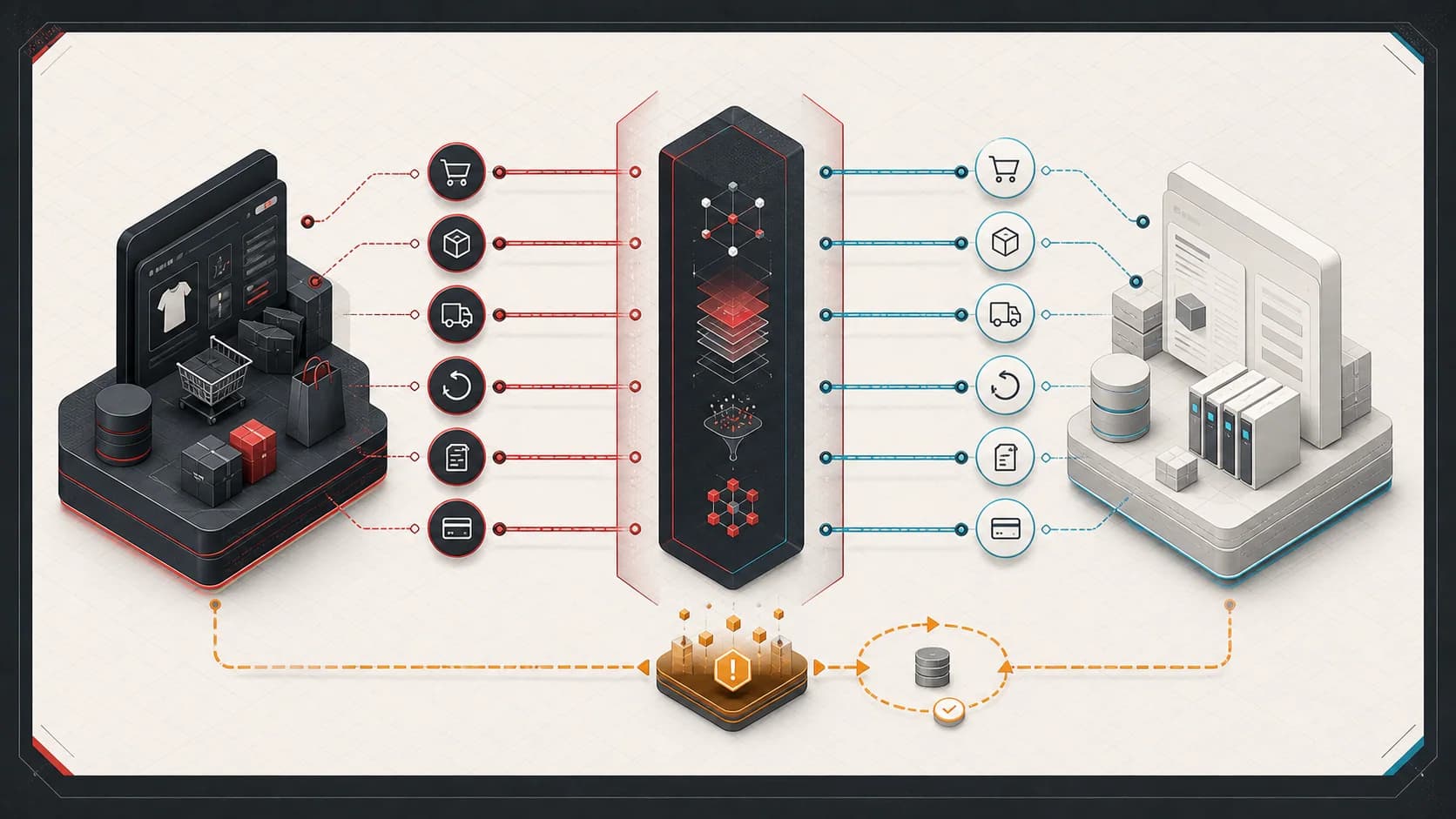
Retries are inevitable in a NetSuite integration.
Networks time out. Rate limits change available capacity. Workers crash. Deployments interrupt in-flight work. Operators replay failed records. Reconciliation discovers a missing effect and submits it again.
If the architecture cannot retry safely, it has only two choices:
- Do not retry and lose business operations.
- Retry and risk duplicate orders, customers, fulfillments, credits, or adjustments.
Idempotency provides a third choice: process the same business operation more than once while converging on one intended outcome.
That requires persistent state. An in-memory cache is not an idempotency design for distributed workers.
At-least-once processing is the useful default
End-to-end exactly-once delivery is usually the wrong promise. A queue may deliver once, but the worker can crash after NetSuite commits and before acknowledging the message. A webhook may arrive once, but an operator can replay the same order through a different path.
Design for at-least-once attempts and exactly-once business intent where the operation requires it.
The boundary matters:
- “Process webhook delivery
abconce” is transport idempotency. - “Create the NetSuite sales order for Shopify order
123once” is business idempotency. - “Apply refund
456to that order once” is a different business operation.
One order can legitimately produce several idempotent operations. Do not use one global “order processed” flag.
Build deterministic keys from immutable identity
A key should identify one intended effect:
<target-capability>:<operation>:<source-tenant>:<source-object-id>
Examples:
netsuite-sales-order:create:store.example:shopify-order-123
netsuite-refund:apply:store.example:shopify-refund-456
netsuite-fulfillment:create:warehouse-a:shipment-789
Include a tenant or account boundary so IDs from different stores cannot collide. Prefer immutable platform IDs over display numbers, mutable SKUs, timestamps, or payload hashes.
A payload hash is still useful. It can detect that two callers reused the same key for materially different input. That should become a conflict, not an automatic update.
Avoid:
- A random UUID generated per retry
- Queue message ID as the only key
- Webhook delivery ID as the only key
- Attempt number
- Worker or deployment ID
- A concatenation of every mutable field
Persist an operation record with a unique constraint
The database is the local coordination point.
A practical operation table contains:
CREATE TABLE integration_operation (
  id uuid PRIMARY KEY,
  idempotency_key text NOT NULL UNIQUE,
  operation_type text NOT NULL,
  source_id text NOT NULL,
  payload_hash text NOT NULL,
  status text NOT NULL,
  target_external_id text NOT NULL,
  target_internal_id text,
  attempt_count integer NOT NULL DEFAULT 0,
  next_attempt_at timestamptz,
  lease_owner text,
  lease_expires_at timestamptz,
  last_error_class text,
  last_error_code text,
  last_error_message text,
  created_at timestamptz NOT NULL,
  updated_at timestamptz NOT NULL
);
The exact schema will vary. The invariants should not:
- One row per idempotency key
- One persisted status transition history or audit trail
- One stable target external identity
- A linked NetSuite internal ID after confirmed success
- Controlled concurrent claiming
- Enough failure evidence to choose the next action
Insert-or-load must be atomic. A SELECT followed by an unprotected INSERT allows two workers to observe absence and both proceed.
NetSuite external IDs are part of the remote boundary
Oracle documents external IDs as synchronization identifiers. For supported REST record operations, an external ID can identify a record independently of the generated internal ID. Oracle's SOAP reliability guidance also recommends external IDs and upsert operations where appropriate.
Use a deterministic external ID derived from the same business identity:
shopify_order_store_example_123
Confirm the allowed characters, uniqueness scope, record support, connector behavior, and account configuration for the chosen interface. External IDs are not globally unique across every NetSuite record type, and not every custom integration path uses them consistently.
NetSuite REST asynchronous processing also documents an X-NetSuite-idempotency-key for avoiding duplicate asynchronous request submission. That is useful for the documented async boundary. Do not assume it provides universal idempotency for every synchronous REST, RESTlet, SuiteScript, SOAP, or connector operation.
Local persistence remains necessary because it coordinates business state across interfaces, workers, retries, and operator actions.
A conceptual TypeScript implementation
The following example is intentionally an architecture sketch. The repository methods imply database transactions, unique constraints, leases, and durable transition history; they are not an in-memory map.
type OperationStatus =
  | 'ready'
  | 'submitting'
  | 'submitted_ambiguous'
  | 'retry_wait'
  | 'needs_attention'
  | 'succeeded'

interface OrderInput {
  shopDomain: string
  shopifyOrderId: string
  payloadHash: string
}

interface Operation {
  id: string
  idempotencyKey: string
  payloadHash: string
  status: OperationStatus
  targetExternalId: string
  targetInternalId?: string
}

interface OperationRepository {
  insertOrLoad(input: {
    idempotencyKey: string
    payloadHash: string
    targetExternalId: string
  }): Promise<Operation>

  claim(operationId: string, allowed: OperationStatus[]): Promise<Operation | null>
  markSucceeded(operationId: string, targetInternalId: string): Promise<void>
  markAmbiguous(operationId: string, error: unknown): Promise<void>
  scheduleRetry(operationId: string, error: unknown): Promise<void>
  markNeedsAttention(operationId: string, error: unknown): Promise<void>
}

interface NetSuiteOrderAdapter {
  findByExternalId(externalId: string): Promise<{ internalId: string } | null>
  create(input: OrderInput, externalId: string): Promise<{ internalId: string }>
}

async function processOrder(order: OrderInput, idempotencyKey: string): Promise<void> {
  const targetExternalId = createNetSuiteExternalId(order)
  const operation = await operations.insertOrLoad({
    idempotencyKey,
    payloadHash: order.payloadHash,
    targetExternalId,
  })

  if (operation.payloadHash !== order.payloadHash) {
    throw new Error(`Conflicting payload for ${idempotencyKey}`)
  }

  if (operation.status === 'succeeded') {
    return
  }

  const claimed = await operations.claim(operation.id, [
    'ready',
    'retry_wait',
    'submitted_ambiguous',
  ])

  if (!claimed) {
    return
  }

  const existing = await netSuiteOrders.findByExternalId(claimed.targetExternalId)

  if (existing) {
    await operations.markSucceeded(claimed.id, existing.internalId)
    return
  }

  try {
    const created = await netSuiteOrders.create(order, claimed.targetExternalId)
    await operations.markSucceeded(claimed.id, created.internalId)
  } catch (error) {
    const failure = classifyNetSuiteFailure(error)

    if (failure === 'ambiguous') {
      await operations.markAmbiguous(claimed.id, error)
      return
    }

    if (failure === 'transient') {
      await operations.scheduleRetry(claimed.id, error)
      return
    }

    await operations.markNeedsAttention(claimed.id, error)
  }
}
Important details:
insertOrLoadis protected by the unique constraint.claimis an atomic state transition with a lease or equivalent concurrency guard.- A previously ambiguous operation performs lookup before create.
- A successful lookup repairs local state without creating another record.
- Transient and permanent failures follow different paths.
- A succeeded operation returns without another NetSuite call.
The example still has an unavoidable ambiguity: NetSuite might commit, the client might time out, and an immediate external-ID lookup might not yet show the record. The correct behavior is to remain ambiguous and reconcile again—not assume absence after one query.
Model state transitions around retry safety
Use states that change what the next worker is allowed to do.
ready → submitting → succeeded
                 ↘ submitted_ambiguous → reconciling → succeeded
                 ↘ retry_wait → ready
                 ↘ needs_attention → ready (after correction)
Do not let submitted_ambiguous transition directly to another create attempt without a reconciliation decision.
Record every transition with:
- Previous and next status
- Actor or worker
- Attempt
- Error classification and code
- Evidence used for reconciliation
- Mapping or policy version
- Timestamp
- Operator reason for replay or correction
This history is both an audit trail and a debugging tool.
Separate failure classes
Transient
Examples include rate limits, temporary dependency unavailability, and some connection failures known to occur before submission.
Retry with bounded exponential backoff, jitter, maximum attempts, and a maximum age. Respect provider guidance and observed account capacity.
Permanent input or business rejection
Examples include missing item mappings, invalid subsidiary or location rules, closed accounting periods, and unsupported state transitions.
Do not keep retrying unchanged input. Route it to an exception workflow with the rejected field and business context visible.
Ambiguous
Examples include timeout, connection reset, or worker termination after a request might have reached NetSuite.
Reconcile by deterministic identity, asynchronous job location where applicable, or a documented account-specific lookup. Keep creation blocked until the result is conclusive.
Internal defect
Unexpected exceptions, serialization defects, and invariant violations need quarantine and alerting. A code deployment may be required before replay.
Replay must reuse identity and intent
Replay is not “create a new job with a new key.”
A safe replay:
- Loads the existing operation.
- Shows prior attempts and remote evidence.
- Requires correction or a reason when the failure was permanent.
- Reuses the same idempotency and target external IDs.
- Continues from the state that remains incomplete.
- Records the operator and mapping version.
If the source payload is immutable, replay it through the current code only when the mapping-version decision is explicit. Changing mappings during replay can produce a different order under the same idempotency key.
Reconciliation is part of idempotency
Idempotency prevents known duplicate attempts. Reconciliation resolves uncertainty and detects paths that bypassed the guard.
Reconcile:
- Ambiguous operations
- Long-running
submittingstates with expired leases - Local successes whose NetSuite records are missing or inconsistent
- NetSuite records with the expected external ID but no local success
- Multiple records that appear to share one source identity
- Operations older than the expected processing objective
When possible, repair links and state automatically. Route financial conflicts, multiple matches, and unexplained differences to humans.
Observability should show prevented work
Track more than failure count:
- Idempotency hits that returned an existing success
- Concurrent claims rejected
- Ambiguous writes awaiting reconciliation
- Reconciliation age and outcomes
- Attempts by failure class
- Operations in
needs_attention - External-ID conflicts
- Operator replays and their results
Log the idempotency key, operation ID, source ID, target external ID, target internal ID, state, attempt, and correlation identifiers. Exclude secrets and sensitive payload fields.
An idempotency hit is often a healthy signal: the system prevented duplicate work. A sudden spike may also reveal upstream retry or delivery problems.
Deploy without changing the identity contract
Operational incidents often appear when a deployment changes key construction, operation type, or external-ID formatting.
During migration:
- Keep old keys readable.
- Add new key versions explicitly rather than silently changing format.
- Backfill operation links before enabling new workers.
- Prevent old and new consumers from creating the same effect under different identities.
- Reconcile the cutover window.
- Test rollback with in-flight ambiguous operations.
Idempotency is a long-lived data contract, not a helper function.
The standard to hold
For every retryable NetSuite effect, the next engineer should be able to answer:
- What business operation does the key identify?
- Where is the operation persisted?
- What uniqueness constraint protects it?
- How is concurrent work claimed?
- How is remote success identified?
- What happens after an ambiguous timeout?
- How is replay authorized?
- How does reconciliation repair state?
- Which dashboard shows unresolved operations?
If those answers are missing, retries are still a duplicate-record risk.
The focused duplicate NetSuite order guide applies this pattern to order creation. The broader Shopify NetSuite integration consulting page covers the audit of ownership, mapping, failure, and recovery boundaries around it.