


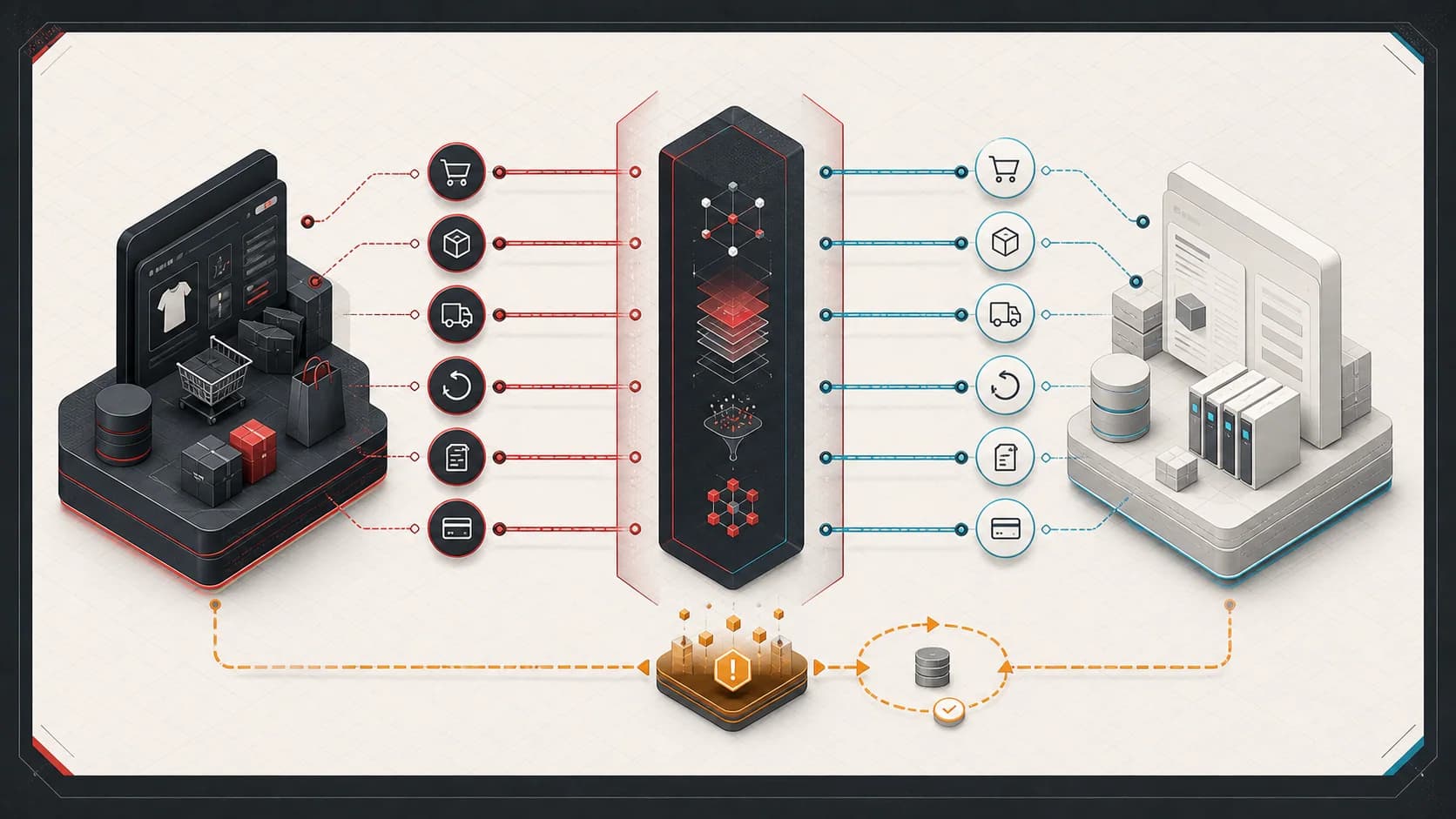
Duplicate NetSuite orders are usually not caused by one obvious bug. They are the predictable result of delivering work at least once while treating a create request as if it happens exactly once.
The critical scenario is this:
- Your integration sends a request to create an order in NetSuite.
- NetSuite creates the record.
- The connection times out before your application receives the response.
- The worker retries.
- A second NetSuite order is created.
The timeout did not mean failure. It meant uncertainty.
Preventing the duplicate requires more than deduplicating Shopify webhooks. It requires an idempotency contract around the business operation and a recovery path for ambiguous outcomes.
Duplicate delivery is normal distributed-systems behavior
An order can be processed more than once because of:
- Shopify webhook redelivery
- Multiple subscriptions for related events
- Queue redelivery after a worker lease expires
- Application retries after transient errors
- A worker crash after NetSuite commits but before local state is updated
- An operator clicking replay
- A reconciliation job importing the same missing-looking order
- A migration or backfill overlapping live processing
Shopify documents that duplicate webhook deliveries can occur and provides delivery IDs for deduplicating individual deliveries. That is useful at ingestion. It is not the complete business idempotency boundary.
If a webhook, backfill, and operator replay can all request “create the NetSuite order for Shopify order 123,” they must converge on the same business operation even though they have different delivery IDs.
Choose a stable business idempotency key
The key should identify the effect you want to happen once.
For order creation:
netsuite-sales-order:create:<shop-domain>:<shopify-order-id>
For a later, independent effect:
netsuite-order-refund:<shop-domain>:<shopify-refund-id>
Good keys are:
- Deterministic
- Based on immutable source identity
- Scoped by business operation
- Independent of attempt number, worker, deployment, or delivery transport
- Stored for as long as a duplicate operation could reappear
Do not use a random UUID generated on every attempt. That produces a unique request, not an idempotent operation.
Do not use a mutable order name or SKU when a stable platform ID is available.
Enforce uniqueness before calling NetSuite
Persist one row per business operation and enforce a unique database constraint on the idempotency key.
A simplified schema might contain:
| Field | Purpose |
|---|---|
idempotency_key | Unique business operation identity |
status | Current processing and recovery state |
source_id | Stable Shopify order identity |
netsuite_internal_id | Result after confirmed success |
netsuite_external_id | Stable cross-system reference |
attempt_count | Bounded retry and support evidence |
last_error_class | Transient, permanent, ambiguous, or defect |
lease_owner / lease_expires_at | Safe concurrent claiming |
payload_hash | Detect conflicting reuse of the same key |
The constraint prevents two workers from independently deciding that no operation exists. Use a transactional insert or an upsert-like claim pattern; do not implement check-then-insert in application memory.
If the same key arrives with materially different immutable input, stop. Silently accepting conflicting payloads under one key hides an upstream ownership problem.
Use NetSuite external identity where the interface supports it
Oracle's documentation describes external IDs as synchronization identifiers and notes that record type plus external ID can identify a record. REST record services can address supported records using an eid: form, while SOAP guidance recommends external IDs and upsert operations for reliable synchronization.
That makes an external ID a useful second line of defense, but it is not a substitute for local operation state.
Why both?
- Local state coordinates workers, retries, leases, mapping versions, and operator actions.
- The NetSuite external identity helps determine whether the remote effect already exists.
- Reconciliation connects the two when one side committed and the other did not.
Confirm uniqueness and supported operations for the specific record type, interface, account configuration, and integration path you use. Do not assume every connector or custom SuiteScript honors external identity the same way.
Model the ambiguous timeout explicitly
The worker should not convert a timeout directly into failed.
Use a state such as submitted_ambiguous and require one of these outcomes before another create:
- Find the NetSuite record by the deterministic external identity.
- Inspect the status of the asynchronous request when the selected REST workflow exposes one.
- Query or search using a documented combination of immutable source fields.
- Route the operation to reconciliation if no authoritative lookup is immediately available.
If the record is found, link its NetSuite internal ID to the local operation and mark the create as succeeded.
If the record is conclusively absent, transition back to a retryable state.
If the evidence is inconclusive, keep the operation blocked from creating again and require deeper reconciliation. Uncertainty is a real state.
Lookup-before-create is useful, but it is not sufficient alone
A naïve pattern looks like this:
if no NetSuite order exists:
  create one
Two workers can both perform the lookup before either create becomes visible. Then both create.
Lookup-before-create is strongest when combined with:
- A local uniqueness constraint
- A single claimed operation
- A deterministic remote identity
- A remote upsert or equivalent supported behavior where appropriate
- Reconciliation after ambiguous outcomes
It is also important to define the lookup precisely. Searching by display order number with LIKE can match the wrong transaction. Prefer exact, immutable external identity.
Make worker concurrency explicit
Duplicate prevention fails under concurrency when:
- A job lock expires during a slow NetSuite request
- Two queue systems can deliver the same business operation
- Manual replay bypasses the normal claim logic
- A deployment starts new workers before old workers drain
- Retry code creates a new operation row instead of reusing the existing one
Use a lease with an expiry and ownership token if operations can be claimed for long-running work. On completion, update the operation only if the worker still owns the lease. If a lease expires while a request may be in flight, the next worker must reconcile rather than blindly create.
Bound parallelism against observed NetSuite capacity and governance behavior. More workers do not improve throughput if they only create rate-limit retries and expired leases.
Keep retries inside a state machine
A durable order operation might move through:
received
  → validated
  → ready
  → submitting
  → succeeded
Alternative transitions include:
submitting → submitted_ambiguous → reconciling → succeeded
validated → needs_attention
ready → retry_wait → ready
The retry handler should load the existing operation. It should never create a new idempotency record for the same business effect.
Permanent mapping failures should not consume transient retry capacity. Operator correction should record who changed what and intentionally transition the same operation back to ready.
For a fuller conceptual implementation, see Idempotency in NetSuite Integrations.
Reconciliation detects what prevention misses
Even a good idempotency design can be bypassed by manual NetSuite entry, an older integration path, or a migration script.
A duplicate-order reconciliation report should look for:
- More than one NetSuite order sharing the same external business identity
- NetSuite orders with no corresponding local operation
- Local successful operations pointing to missing or unexpected remote records
- Ambiguous operations older than their expected resolution window
- Conflicting totals, currencies, customer identities, or line counts
The report should not automatically delete or merge financial records. It should create an owned exception with enough evidence for finance or operations to decide the correction.
SuiteQL can help with account-specific duplicate and reconciliation queries. The existing sales-order SuiteQL guide demonstrates the query patterns, while the exact external-ID and transaction filters must be verified for the account.
Test the failures, not only the happy path
At minimum, exercise these cases:
- Two identical webhook deliveries arrive concurrently.
- A queue message is redelivered after the worker starts.
- The NetSuite request fails before it is sent.
- NetSuite rejects a permanent mapping or business rule.
- NetSuite creates the order and the client times out.
- NetSuite creates the order and the local success update fails.
- An operator replays a succeeded order.
- A new deployment overlaps an old worker.
- A reconciliation import sees an existing order.
Assertions should cover business outcomes: exactly one NetSuite order, one local operation identity, a linked internal ID after recovery, bounded attempts, and a visible exception when the result cannot be proven.
The practical rule
Never ask “Can I retry this request?”
Ask:
Can I prove the intended business effect has not already happened?
If the answer is no, reconcile before creating again.
The broader Shopify-to-NetSuite order sync architecture shows where this idempotency boundary fits in ingestion, mapping, processing, observability, and manual recovery. If duplicates are already reaching finance or fulfillment, the Shopify NetSuite integration consulting page explains the audit and remediation approach.