


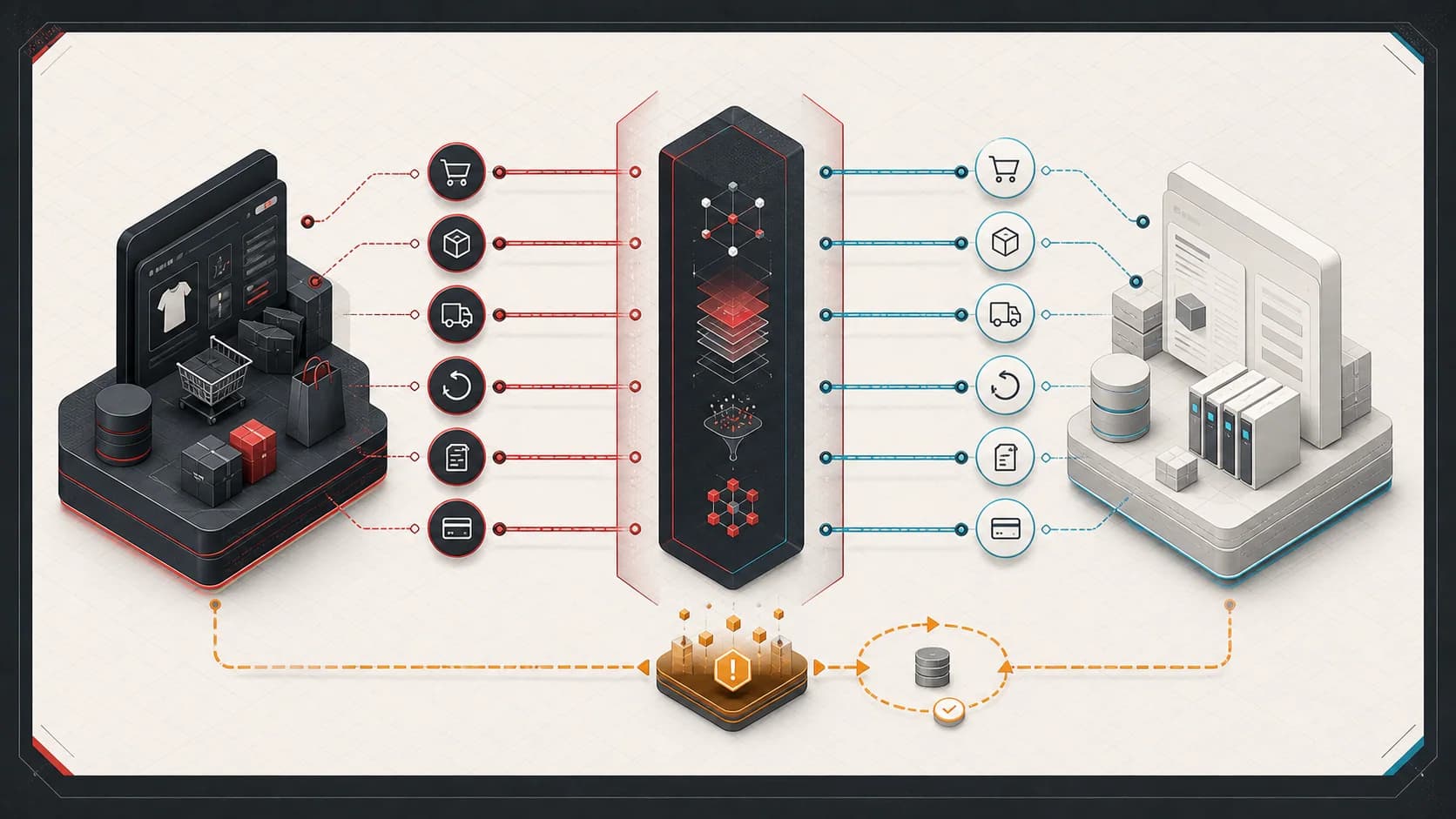
The business problem is not “send a Shopify order to NetSuite.” It is making sure one customer purchase produces the correct operational and financial records even when webhooks are duplicated, NetSuite is slow, mappings change, a deployment interrupts processing, or a request succeeds but the response never reaches your application.
The fragile version is familiar:
Shopify webhook → call NetSuite → hope it succeeds
That can pass a demo. It also couples Shopify's delivery window to NetSuite latency, makes retries dangerous, and leaves little evidence when the two systems disagree.
A production order pipeline needs a durable boundary between receiving a commerce event and performing an ERP operation:
Shopify → ingestion → validation → durable processing → NetSuite → reconciliation → operational visibility
The exact queue, database, connector, or cloud service is secondary. The contracts at each step are what determine whether the pipeline can recover.
Acknowledge receipt after durable acceptance
A webhook handler should do a small amount of work:
- Verify that the request came from Shopify.
- Capture the delivery metadata and raw or losslessly serialized payload.
- Persist the event or enqueue it durably.
- Return a successful response.
Shopify's current webhook guidance explicitly calls out duplicate deliveries, delivery ordering, and reconciliation. It also recommends moving slow processing out of the request path. See Shopify's official documentation on webhook behavior and delivery troubleshooting.
“Acknowledge quickly” does not mean “fire an untracked promise and return.” If the process crashes after the response but before the work is durable, Shopify believes the delivery succeeded and the order may never reach NetSuite.
The durable write and acknowledgement form the first reliability boundary.
Keep the Shopify payload, but do not make it the domain model
Preserve the source payload for evidence and replay. Then translate it into an internal order representation with explicit business meaning.
That internal model might distinguish:
- Shopify order identity from the customer-facing order name
- Product variant identity from SKU and NetSuite item identity
- Merchandise, shipping, discount, tax, gift-card, and fee lines
- Payment authorization, capture, tender, and settlement information
- Fulfillment location and routing intent
- Source timestamps from the time your application received the event
This is not an argument for a giant universal commerce schema. Model only the information needed to make the integration's decisions stable and testable.
The benefit is containment. When Shopify changes a payload or NetSuite requires a different form, the mapping changes at an adapter boundary instead of leaking through every processing step.
Define the business operation before choosing the idempotency key
A Shopify webhook delivery ID identifies one delivery. It does not necessarily identify the business operation “create the NetSuite order.”
The same order could reach the integration through:
- An original webhook
- A duplicate webhook delivery
- A later order update
- A reconciliation import
- An operator replay
- A backfill during migration
If each path gets a new idempotency key, all of them can create the same NetSuite order.
Use a deterministic key based on the intended business operation, for example:
shopify-order-to-netsuite-sales-order:<shop-domain>:<shopify-order-id>
Persist that key with the processing state and enforce uniqueness in the database. Where the chosen NetSuite record type and integration interface support it, use the same stable identity as an external reference. Oracle documents external IDs as synchronization keys that can identify records independently of NetSuite's generated internal IDs.
The idempotency record should also retain the NetSuite internal ID after success. That makes later updates and reconciliation deterministic.
For the full failure model, see Idempotency in NetSuite Integrations.
Make mapping a versioned decision
Order mapping is business logic, not serialization.
Before creating a NetSuite transaction, the integration may need to decide:
- Which customer or fallback customer record applies
- How guest checkout and B2B accounts differ
- Which subsidiary, location, department, class, or channel applies
- How bundles become parent, component, or fulfillment lines
- How discounts, shipping, gift cards, deposits, and taxes are represented
- Whether the expected downstream record is a sales order or another configured transaction flow
- Which payment and fulfillment states are safe to advance
Some of these outcomes vary by NetSuite configuration, accounting policy, connector behavior, and custom forms. Do not present one mapping as universal.
Store a mapping or policy version with the operation. If an operator replays an order after a configuration change, the system should make the choice explicit: use the original mapping for determinism, or intentionally remap under the new version.
Separate transient, permanent, and ambiguous failures
“Retry on error” is not a policy.
| Failure class | Example | Correct next action |
|---|---|---|
| Transient | Rate limit, temporary dependency failure | Retry with bounded backoff and jitter |
| Permanent input | Missing item mapping, invalid subsidiary | Stop and route to correction |
| Business rejection | Closed period or invalid state transition | Escalate with the rejected rule visible |
| Ambiguous write | Timeout after sending the create request | Look up or reconcile before another create |
| Internal defect | Unexpected exception or schema assumption | Quarantine, alert, fix, then controlled replay |
The ambiguous case is the most dangerous. A timeout says that the client did not receive a conclusive response. It does not prove that NetSuite rejected the write.
Blindly retrying a create request converts uncertainty into a duplicate order. The recovery path must first query by stable external identity, inspect the asynchronous job if that interface was used, or reconcile against other identifying fields when necessary.
Treat partial failure as state, not an exception string
Order synchronization often contains several effects: normalize the order, resolve reference data, create or find the NetSuite record, persist the returned ID, attach supporting data, and publish the outcome.
If the NetSuite record is created but the local success update fails, the business operation succeeded even though the application operation did not finish.
Use explicit processing states such as:
receivedvalidatedreadysubmittingsubmitted_ambiguoussucceededneeds_attentionreconciling
The names matter less than the transitions. Every transition should answer:
- What durable evidence exists?
- Is another create safe?
- Who or what owns the next action?
- Can the operation be replayed?
- How will completion be confirmed?
Avoid a state machine with dozens of technical micro-states. Model the business decisions that change recovery behavior.
Reconciliation closes the reliability gap
Webhooks reduce latency. They do not prove completeness.
A reconciliation job should compare expected Shopify orders with actual NetSuite records over a bounded period. Depending on the workflow, it can detect:
- Shopify orders with no NetSuite record
- Multiple NetSuite records for one stable order identity
- Orders stuck in an in-progress or ambiguous state
- NetSuite records missing a local operation link
- Material total, currency, customer, line, or status differences
Use a moving window with overlap so late updates and delayed events are checked again. Store a checkpoint, but do not assume the checkpoint makes the source immutable.
SuiteQL can support this operational visibility when the relevant account tables and fields are understood. The existing NetSuite SuiteQL examples show practical sales-order, line, fulfillment, and inventory queries without pretending those queries are account-independent.
Observability must follow the order
Infrastructure metrics tell you whether the worker is running. Operations needs to know whether a specific order is safe.
Every log, trace, audit record, and exception should carry the identifiers needed to cross the boundary:
- Internal operation ID
- Shopify shop and order ID
- Shopify webhook delivery ID when applicable
- Business idempotency key
- NetSuite record type, external ID, and internal ID when known
- Attempt number and failure classification
- Mapping version
- Operator action and replay reason
Useful service-level indicators include age of the oldest unprocessed order, time from durable ingestion to confirmed NetSuite record, ambiguous operations awaiting reconciliation, duplicate prevention hits, and exceptions by reason.
This complements—not replaces—the broader monitoring described in API Monitoring for Revenue-Critical Order Flows.
Manual recovery is part of the product
Some failures require business judgment. The system should make that work safe.
An operator needs to see the source event, normalized order, identifiers, mapping version, attempts, NetSuite evidence, and failure classification. The allowed actions should be bounded:
- Retry a transient operation
- Reconcile an ambiguous submission
- Correct a mapping and replay
- Link an existing NetSuite record
- Suppress a known non-order
- Escalate a financial or data-ownership conflict
Do not give every operator a generic “run again” button. Recovery actions should enforce the same idempotency and state-transition rules as automated processing.
Deployments and migrations must preserve in-flight work
A reliable design can still duplicate orders during a rollout if old and new workers consume the same work under different keys.
Before changing the pipeline:
- Keep idempotency-key construction backward compatible.
- Make schema changes additive before workers depend on them.
- Drain or deliberately share old queues.
- Version mapping separately from deployment versions.
- Test replay of historical payloads.
- Reconcile the cutover window.
- Keep rollback from re-enabling an unsafe create path.
The survivorship test is simple: if the original engineer leaves, can another engineer explain why an order is pending, determine whether a retry is safe, and complete the workflow without editing production tables by hand?
That is the difference between a connector that moves data and an order capability the business can operate.
For a review of the complete boundary—not just the worker—see Shopify NetSuite integration consulting.