


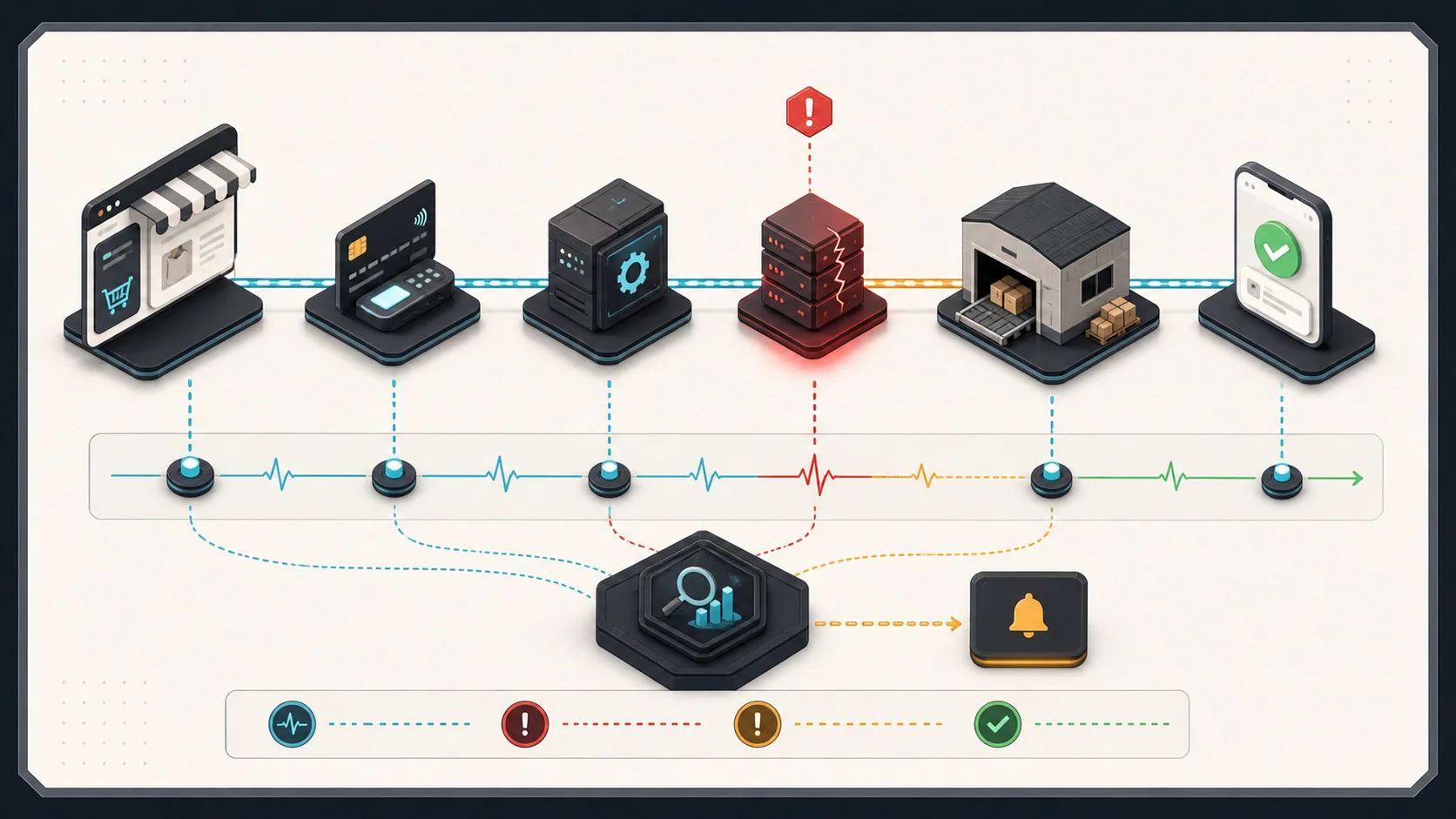
An API can be technically up and still be failing the business. The endpoint returns 200, but orders are not moving. A webhook is accepted, but a background job is stuck. A fulfillment update arrives, but tracking never reaches the customer.
For revenue-critical order flows, monitoring has to prove business outcomes, not just server health.
This is part of broader systems integration consulting: the integration is only useful when teams can see, trust, and recover the flow.
Health checks are not enough
A basic health check answers one question: can the server respond?
Order flow monitoring needs better questions:
- Can Shopify create an order?
- Did NetSuite receive it?
- Did the warehouse get the fulfillable lines?
- Did tracking flow back?
- Did billing happen?
- Did failed records enter an exception queue?
The integration is healthy only when the expected business state changes.
Monitor the workflow, not just the endpoint
A revenue-critical order flow often crosses several systems:
- Storefront
- Payment processor
- ERP
- Warehouse management system
- Shipping platform
- Email or SMS provider
- Internal reporting database
Each handoff needs an observable checkpoint. Logs should include the same correlation identifiers across systems: order number, external ID, NetSuite internal ID, fulfillment ID, tracking number, and customer-facing reference.
Without correlation, debugging becomes a search party.
Define expected timing
Monitoring should know what normal timing looks like.
Examples:
- Orders should sync to the ERP within five minutes.
- Fulfillment updates should post tracking within fifteen minutes.
- Billing jobs should complete by a specific time each day.
- Failed records should alert within one retry cycle.
- No order should remain in pending sync for more than one hour.
These are business service-level expectations. They are more useful than a CPU graph when the issue is operational.
Track exceptions as first-class records
Do not bury integration failures only in logs. Logs are for engineers. Exception records are for operations.
An exception record should include:
- Source system
- Destination system
- External ID
- Error message
- Last attempt time
- Retry count
- Whether retry is safe
- Suggested next action
That last field matters. A good monitoring system helps the team recover, not just panic.
Use synthetic checks carefully
Synthetic checks can be useful when they simulate a real order path. But they should not create accounting noise, inventory movement, or customer-facing records unless the system has a safe test mode.
Safer synthetic checks include:
- Read-only API calls
- Test customer records
- Sandbox transactions
- Dry-run payload generation
- Querying for recent expected records
For NetSuite, SuiteQL reports can help confirm that recent orders, fulfillments, or billing records exist without creating new transactions.
Alert on missing movement
Some integration failures are silent. Nothing crashes; records just stop moving.
Alert on stuck states:
- Orders created but not synced
- Synced orders with no ERP ID
- Fulfilled orders with no tracking
- Fulfillments with no billing action
- Failed jobs with no retry
- Queues that stop draining
Missing movement is often the earliest signal that revenue operations are at risk.
Monitoring is part of the product
If an integration handles orders, payments, inventory, or fulfillment, monitoring is not optional infrastructure. It is part of the product.
The business does not care that the endpoint was up. It cares that orders moved correctly. Build monitoring around that truth.
For the durable processing and recovery path behind those checkpoints, see Shopify to NetSuite Order Sync: Architecture That Survives Production. When a retry may duplicate the remote record, use the state and reconciliation model in Idempotency in NetSuite Integrations.