


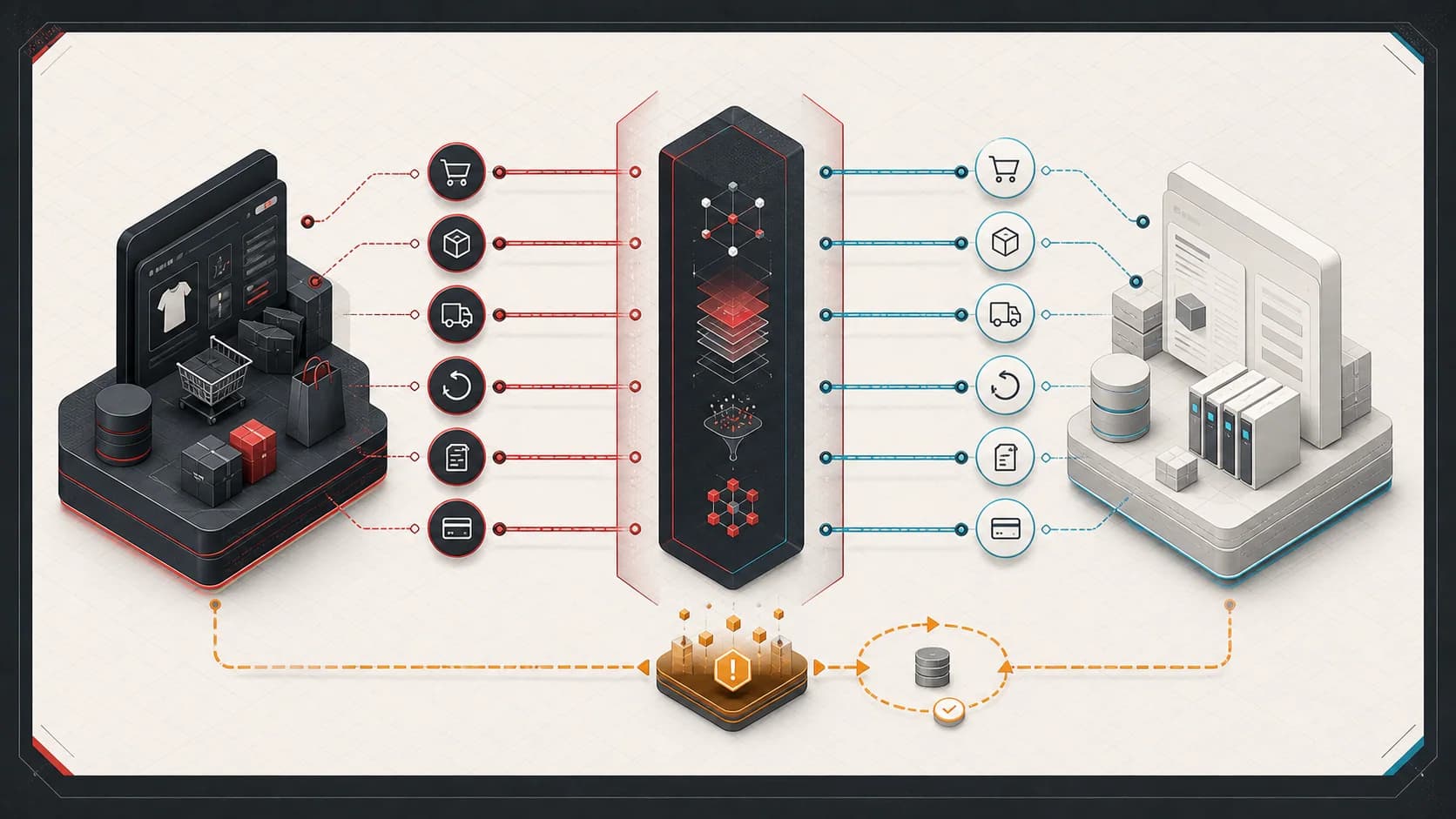
A refund is not the inverse of order creation.
Consider an illustrative case: a customer receives two items, then gets a partial refund for one damaged item that they keep. The payment provider confirms the refund, but the request to record it in NetSuite times out.
Support needs to know whether the customer has been paid. Finance needs the correct accounting record. The warehouse should not put an item back into stock when it never came back. A single “refunded” status cannot answer all three questions.
A Shopify-to-NetSuite refund integration must separate:
- What refund or cancellation occurred for the customer?
- Which financial records should represent it in this NetSuite account?
- Which inventory or fulfillment actions, if any, should follow?
The answers depend on accounting policy, account configuration, payment flow, and timing. There is no universal rule that every Shopify refund becomes one specific NetSuite transaction type.
Refund and cancellation are different business operations
A cancellation usually stops future work. A refund returns money. They can happen together, but not always.
- An unfulfilled order is cancelled before payment is collected. The payment hold may need to be released rather than refunded.
- A customer receives a partial refund and keeps the item, as in our example.
- A returned item is received and restocked before the financial refund is issued.
- A goodwill shipping refund changes money but not item quantity.
- A fraud cancellation stops an order when there are no collected funds to return.
Keep cancellation, payment reversal, financial credit, return, and restock separate in the model. Link them where the business process requires it. Otherwise, retrying a failed accounting update could repeat an action that already succeeded elsewhere.
Give each refund a stable identity
An order can have several refunds. Identifying work only by order ID cannot distinguish a new partial refund from another attempt to process the first one.
Give each refund or adjustment a stable operation reference. For a Shopify refund, it could be:
shopify-refund-to-netsuite:<shop-domain>:<shopify-refund-id>
Reuse that identity when the same notification arrives again or a worker retries the operation. Keep the original source evidence, and record later status changes and corrections without replacing its history.
The record needs enough detail to explain the decision later:
| Evidence | What to retain |
|---|---|
| Identity and timing | Shopify order and refund IDs; created and processed timestamps |
| Original sale | NetSuite order and billing records; source line IDs and their NetSuite line references |
| Money | Currency, item amounts, quantities, shipping, tax, discounts, duties, fees, and payment-method allocations |
| Inventory | Restock instructions and location when supplied |
| Policy | The mapping rules and accounting-policy version used |
| Outcome | Records created or linked; attempts, failures, checks, and operator actions |
Translate the source data into the business's refund model before choosing the NetSuite actions. The source event provides evidence; it does not decide the accounting policy.
Partial and multiple refunds must add up
Do not validate each refund only in isolation. Track the totals across the order, including money returned, quantities refunded, shipping, tax, discounts, and amounts returned through each payment method. Keep returned and restocked quantities separate from refunded quantities.
In our example, the damaged item has already received a partial refund. A later request must take that refund into account before returning more money.
Two workers can both read an old “remaining refundable amount” and each decide their request is valid. Prevent that race by processing updates one at a time per order, or by checking and saving the totals in one database transaction. This protects the integration's own decisions; it does not lock external systems or replace their checks.
These rules are cumulative invariants: conditions that must remain true across the complete refund history, not just one request.
The totals do not have to look identical in every system. Rounding, tax rules, discounts, and currency conversion can produce valid differences. Each difference must be expected, within an agreed limit, and explainable by comparing the records.
Line identity must survive the original order mapping
A Shopify line may have become one NetSuite line, several bundle components, a different accounting item, or several lines across locations or fulfillments.
Use the mapping saved when the order was created. Do not reconstruct it from today's product catalog. Product codes and bundle definitions can change before the customer requests a refund.
For our damaged item, the original source line ID and its NetSuite references identify which sale is being adjusted. A matching product name alone is not enough.
For bundles, finance and the implementation team must decide whether the refund belongs across component lines, at the parent level, or on a configured accounting item. Match that treatment to how the original order was recorded.
Shipping, tax, and discounts need explicit allocation rules
A shipping refund may be full, partial, or a goodwill credit with no returned item.
Tax treatment can depend on the refunded lines, jurisdiction, tax provider, shipping, discounts, and rounding. It also matters whether NetSuite recalculates tax or receives explicit amounts.
Discounts need the same care. When one item from a discounted order is refunded, how much of the discount belongs to that item? Shopify's amounts and NetSuite's financial records may represent that allocation differently.
Do not hide a small difference by adding it to an arbitrary line. Agree with finance on rounding, tolerances, and adjustment rules. Differences outside those rules need investigation.
Gift cards and multiple payment methods are tender problems
A tender is a payment method. One order may use a card, wallet, gift card, store credit, manual payment, or several methods together. The integration must record how the refund is allocated across them.
A Shopify refund record does not by itself prove that money reached the customer. Shopify's Refund documentation explicitly separates the refund record from the status of its payment transactions.
A NetSuite credit also does not prove that the customer received funds. Track the customer request, each payment outcome, and the accounting records separately. They may reach completion at different times.
Cash refunds, credit memos, and other NetSuite outcomes vary
NetSuite distinguishes credits owed to a customer from records used to refund money. The appropriate flow depends on the original sale and account configuration. See Oracle's customer credits and refunds overview.
Your workflow may involve a credit memo, cash refund, customer refund, return authorization, or several related records. Closing order lines or adjusting inventory may be separate actions. Do not treat these records as interchangeable.
Define a decision table with finance using:
- The original NetSuite transaction and whether it was billed
- Fulfillment and return status
- Refund reason, amounts, and payment methods
- Subsidiary, currency, tax rules, and accounting period
- Any inventory movement
- Existing connector or SuiteScript behavior
Finance should approve the expected records and the evidence needed to verify them. The integration implements that policy; it should not invent accounting treatment.
Idempotency must cover every effect
Idempotency means that repeating the same operation does not repeat its business effect. A duplicate notification must not create a second credit or send the customer's money back twice.
First establish which system owns the payment refund. If Shopify or another system has already initiated it, the integration should track that outcome and create the required accounting records. It must not initiate another payment merely because NetSuite needs an update.
Use a stable key for the source operation, and separate stable keys for downstream actions that can finish independently. Save the resulting record IDs. Database uniqueness rules should prevent two workers from claiming the same action at once.
A local uniqueness rule alone cannot prove what happened in a remote system. After an uncertain response, the integration needs a way to find or reconcile the original request before submitting another one.
Illustrative case: partial refund; customer keeps the damaged item
Provider confirmed success.
Do not send another refund.
Submission timed out. Outcome unknown.
Find the original record before deciding to retry.
Item stayed with the customer.
No return or restock for this case.
These are separate outcomes, not sequential steps. An uncertain accounting record does not justify repeating the payment or moving stock.
In this example, check whether NetSuite created the credit despite the timeout. If it did, link that record to the operation. If it did not, retry only after establishing that another submission is safe. If the outcome remains unknown, keep it open for investigation.
The NetSuite idempotency guide covers saved processing states, uncertain writes, and operator retries in more detail.
Classify retry behavior by outcome
| Outcome | Next action |
|---|---|
| Rate limit or temporary outage, with no uncertain write | Retry within a limit, increasing the delay and varying it so workers do not all retry together |
| Missing original order mapping | Stop and correct the mapping |
| Accounting-period or business-rule rejection | Route to finance or operations |
| Timeout after submitting a NetSuite record | Check the original submission before another create |
| Payment succeeded; NetSuite update failed | Resolve or retry only the NetSuite action, according to its outcome |
| Conflicting cumulative refund amount | Block the action and investigate the totals |
An operator retry must reuse the same operation and downstream action keys. A generic “retry the refund” button is dangerous if staff cannot see which actions already succeeded.
Reconcile money, records, and inventory separately
Reconciliation means comparing the expected outcome with the records in each system and explaining any differences.
Customer and payment state
Compare refunds recorded in Shopify with the transactions accepted or completed by each payment provider. Distinguish released payment holds from refunds of collected money. Keep pending and failed outcomes visible.
NetSuite financial state
Check the expected credit or refund records, amount, currency, tax, and original transaction. Include the accounting period and account-specific status. Look for duplicates and records that were created but never linked to the operation.
Inventory and return state
Track the quantity marked for return, physically received, inspected, and returned to sellable stock. Preserve location, lot, bin, or serial details where required.
These timelines can differ legitimately. The operator should be able to tell whether a gap is an expected delay, a business hold, or a failed integration action.
Give operators evidence and bounded actions
Show the original order, each refund, line allocations, payment methods, source IDs, NetSuite records, attempts, and unresolved differences together.
Then give staff actions that match the problem:
- Check one uncertain NetSuite submission
- Retry only an incomplete financial action
- Link a verified existing NetSuite record
- Correct a line or payment-method mapping and retry with the same operation identity
- Record an expected difference and its reason
- Escalate an accounting-policy decision
Do not expose raw “create credit” and “send refund” buttons without duplicate prevention and checks against the order's refund history.
Test refund sequences, not only individual examples
Test what happens over time, not just whether one request succeeds:
- Cancellation before fulfillment and payment collection
- Full refund after fulfillment
- Partial refund when the customer keeps the item
- Partial refund followed by a later physical return
- Two refunds against the same line, including concurrent attempts
- Shipping-only refund or tax correction
- Refund of a discounted bundle
- Gift-card plus card payment
- Payment success followed by a NetSuite timeout
- NetSuite success followed by failure to save the result locally
- Duplicate notification followed by an operator retry
After each sequence, check customer money, NetSuite records, and inventory independently.
The customer should receive the intended refund once. Finance should be able to explain the records. The warehouse should move stock only when the physical process calls for it. A reliable integration keeps those promises separate enough to recover each one safely.
The Shopify-to-NetSuite failure guide shows how refunds interact with orders, payments, fulfillment, and finance. For a review of a live implementation, see Shopify NetSuite integration consulting.