


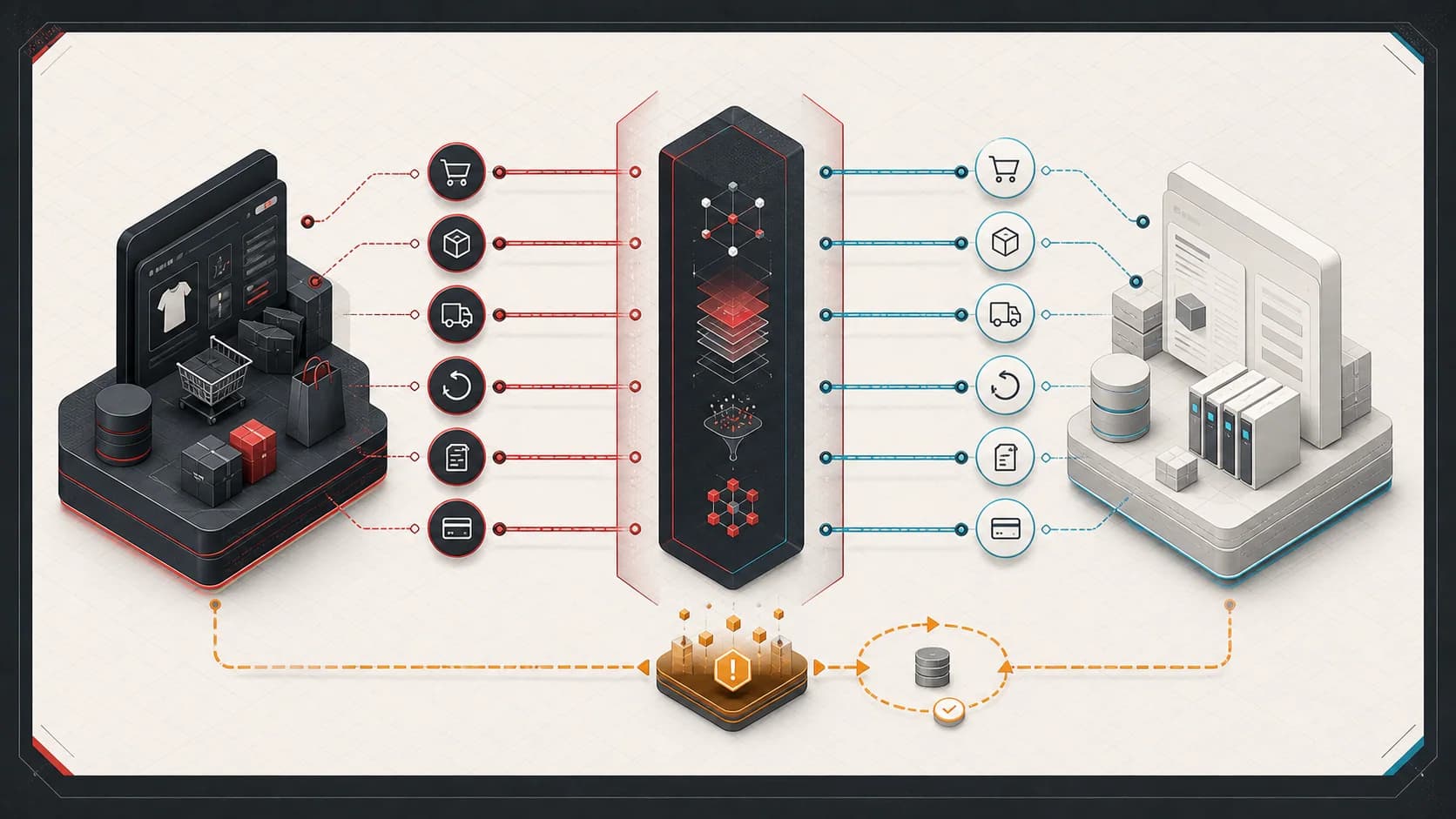
A basic Shopify-to-ERP integration moves records. A business-critical integration preserves capabilities when systems are slow, data is inconsistent, vendors change, and people need to recover the work.
The architecture changes when ecommerce is no longer a secondary channel:
- An order sync failure affects revenue and fulfillment.
- Inventory drift creates oversells or suppresses sellable stock.
- Payment and refund differences reach finance.
- Customer identity conflicts affect service and reporting.
- A deployment can duplicate or strand in-flight work.
- Operational recovery becomes a daily business process, not an engineering edge case.
This article uses NetSuite as a practical example, but the decisions apply to other ERPs. The goal is not a universal connector design. It is a way to assign ownership and failure behavior across systems that represent the same business differently.
Start with capabilities, not endpoints
“Shopify integrates with the ERP” hides several independent workflows:
- Product publication
- Pricing
- Customer identity
- Order acceptance
- Payment representation
- Inventory availability
- Allocation and fulfillment
- Cancellation and returns
- Refunds
- Tax and financial reconciliation
Each capability has different timing, ownership, consistency, and recovery needs.
Inventory may tolerate a few minutes of projection delay but needs systematic reconciliation. Payment and refund workflows may require stronger audit evidence. Product enrichment might be eventually consistent and rebuildable. Order creation may need a strict duplicate-prevention boundary.
Do not force every capability through one generic “sync engine” if the engine erases those differences.
Assign one owner for each business fact
Shopify and an ERP can both store products, customers, orders, inventory, fulfillment, and payment information. Storage does not imply ownership.
A decision table might look like this:
| Capability | Command owner | Other-system role | Key reconciliation question |
|---|---|---|---|
| Product master | ERP, PIM, or commerce team policy | Channel projection | Are required sellable attributes published? |
| Customer identity | CRM, ERP, or identity capability | Channel/customer projection | Which records represent the same customer? |
| Order acceptance | Shopify or order capability | ERP operational/financial record | Does every accepted order have one intended ERP record? |
| On-hand inventory | ERP or WMS | Shopify receives sellable projection | Does channel availability match policy? |
| Fulfillment | WMS, ERP, or OMS | Shopify receives customer-facing status | Do line, location, package, and tracking states agree? |
| Payment settlement | Payment provider/finance process | ERP financial representation | Do captured, refunded, settled, and posted amounts reconcile? |
| Returns | Returns/warehouse process | Shopify and ERP receive relevant state | Are customer, inventory, and financial outcomes consistent? |
The actual owner varies. The discipline does not.
“Bidirectional” should describe transport only after command ownership and conflict behavior are defined.
Keep vendor models at the boundary
Shopify's order schema is not the business order model. An ERP transaction record is not the whole customer purchase.
Use internal contracts around stable business operations:
- Accept commerce order
- Publish sellable inventory
- Record payment outcome
- Request fulfillment
- Confirm shipment
- Apply customer refund
- Reconcile financial state
Adapters translate those operations into Shopify, NetSuite, or another ERP.
This boundary prevents vendor-specific IDs, statuses, payload shapes, and error codes from spreading through orchestration. It also makes a connector replaceable without pretending replacement is only an API-client change.
The tradeoff is more mapping and explicit contracts. That cost is justified where the business capability is expected to outlive the current vendor or integration path. Do not abstract low-risk, one-off behavior merely for aesthetic symmetry.
Orders need durable ingestion and one creation identity
A direct chain:
Shopify webhook → create ERP order → respond
couples event delivery to ERP latency and creates ambiguity when the request times out.
A safer flow is:
event ingestion → durable operation → normalization → mapping → idempotent ERP effect → reconciliation
The order operation needs a stable key independent of webhook delivery, worker, retry, backfill, or operator replay. Persist the ERP internal identity after success and reconcile ambiguous submissions before another create.
The Shopify-to-NetSuite order sync guide details this pipeline, and the duplicate-order guide focuses on ambiguous timeouts and concurrency.
Customer synchronization is an identity problem
Customer records look simple until the same person buys:
- As a guest and later creates an account
- With several email addresses
- For a company under B2B terms
- Through a marketplace
- At a retail location and online
- In more than one subsidiary or currency context
Email may be a useful lookup attribute, but it is not an immutable global identity. Define matching policy, confidence, merge authority, and manual-review behavior.
Avoid creating a new ERP customer whenever an exact lookup fails. Network ambiguity can duplicate customers just as easily as orders.
Some architectures deliberately use a default ecommerce customer for eligible consumer orders and store customer detail on the transaction. Others maintain individual ERP customers. The right choice depends on finance, service, tax, reporting, privacy, and B2B requirements.
Products and pricing should not become one undifferentiated sync
Product identity, merchandising content, channel publication, pricing, and ERP item accounting are different responsibilities.
An ERP might own item identity and cost while Shopify owns merchandising copy and media. A pricing service might own channel price. A PIM might own enriched attributes. NetSuite may be the practical source for some businesses and not others.
Define stable item mappings for:
- Products and variants
- Units of measure
- Bundles, kits, and components
- Gift cards and stored value
- Shipping, discount, tax, deposit, and fee lines
- Inactive or replaced SKUs
- Location and subsidiary eligibility
When mappings change, preserve the version used by historical orders and refunds.
Inventory is a projection, not a mirrored integer
ERP on-hand quantity, ERP available quantity, reservations, commitments, safety stock, channel allocation, and Shopify sellable inventory answer different questions.
Assign ownership for each fact and publish a calculated channel projection. Use event-driven updates for latency and scheduled reconciliation for completeness.
The dedicated Shopify and NetSuite inventory architecture covers locations, reservations, fulfillment timing, returns, adjustments, drift, and recovery. The principles apply when the ERP is not NetSuite.
Payment state and ERP records are not interchangeable
Shopify can show order payment state while one or more payment providers own authorization, capture, refund, dispute, and settlement outcomes. The ERP represents those outcomes according to financial policy.
The integration needs to distinguish:
- Authorized versus captured
- Captured versus settled
- Consumer payment versus payment terms
- Gift card or store credit versus external tender
- Refund requested versus provider-confirmed
- Gross transaction versus fees and payout
Do not infer settlement from order creation. Reconcile payment-provider evidence with ERP financial records under finance-approved tolerances and timing.
Fulfillment crosses more than two systems
A real flow may include Shopify, ERP, OMS, WMS, 3PL, carrier, and store fulfillment.
The architecture needs stable identities for:
- Order and order line
- ERP transaction and line
- Allocation
- Fulfillment or shipment
- Package
- Tracking number
- Location
- Return
Partial shipment, split location, substitution, backorder, bundle components, cancellation, and carrier correction all challenge a single fulfilled: true model.
Choose which system commands fulfillment and which systems receive projections. Reconciliation should compare line quantities and package identities, not only top-level status.
The existing NetSuite fulfillment SuiteQL guide shows practical record relationships for one ERP.
Returns and refunds are related, not identical
The customer may be refunded before the item returns. An item may return but fail inspection. A shipping refund may not involve inventory. A cancellation before capture may require a void rather than a refund.
Model:
- Cancellation
- Return authorization
- Physical receipt
- Inspection and disposition
- Inventory restock
- Payment reversal
- ERP financial credit
as separate operations connected by shared identity.
The Shopify-to-NetSuite refund guide discusses partial and multiple refunds, shipping, tax, discounts, gift cards, payment methods, idempotency, and implementation-dependent NetSuite outcomes.
Queues move work; they do not define reliability
A durable queue is useful when external systems are slow or unavailable. It provides buffering, redelivery, and independent worker capacity.
It does not automatically provide:
- Business idempotency
- Correct ordering
- Mapping validation
- Remote duplicate prevention
- Failure classification
- Reconciliation
- Operator recovery
Use one queue per service only when isolation or ownership justifies it. A small team may be better served by PostgreSQL-backed jobs and explicit modules than a larger event platform it cannot operate confidently.
Choose the simplest durable mechanism that meets throughput, latency, isolation, and recovery needs.
Retry policy belongs to the boundary
Different ERP and commerce effects have different risk:
- Product projection can often be rebuilt from current state.
- Inventory publication can often recalculate rather than replay deltas.
- Order creation must prevent duplicate remote records.
- Refund effects must avoid returning money twice.
- Fulfillment updates must preserve line and shipment identity.
Classify transient, permanent, ambiguous, and internal failures. Apply bounded retries only where the operation is safe.
The NetSuite idempotency guide provides a persistent state-machine pattern that generalizes to other ERPs.
Reconciliation is a first-class integration path
Events answer “what changed recently?” Reconciliation answers “do the systems agree?”
Build reconciliation around business invariants:
- One intended ERP order per accepted commerce order
- Published sellable inventory matches the current projection
- Fulfilled line quantities match shipment evidence
- Customer refunds match payment and financial records
- Integration operations do not remain ambiguous beyond their objective
Use overlapping time windows, checkpoints, and account-specific queries. A reconciliation job must be idempotent too; discovering a difference should not blindly create the missing-looking effect.
Observability must serve operations
Dashboards should expose:
- Age of oldest unprocessed operation
- Throughput and latency by business capability
- Retry and failure classification
- Ambiguous writes awaiting reconciliation
- Mapping and identity conflicts
- Drift by inventory, payment, fulfillment, and refund workflow
- Exception ownership and age
- Replay and operator action history
Every record needs cross-system identifiers. “POST returned 500” is insufficient when support needs to know whether order #1042 can be shipped.
The API monitoring guide covers business-flow health beyond endpoint uptime.
Operational tooling is part of the architecture
The system is incomplete if recovery requires an engineer to query production databases and invoke vendor APIs manually.
Give authorized operators bounded actions:
- Inspect source, normalized, and target records
- Correct mappings
- Retry a transient effect
- Reconcile an ambiguous submission
- Link an existing ERP record
- Republish a projection
- Suppress a known invalid operation
- Escalate a financial or ownership conflict
Apply the same validation, idempotency, authorization, and audit rules as automated processing.
Migrate capability by capability
Replacing an ERP, connector, or middleware layer is not a single cutover.
Sequence the change:
- Define stable capability contracts and identifiers.
- Capture current inputs and outcomes.
- Build the new path behind the same business operation identity.
- Run in shadow or controlled parallel mode.
- Compare outputs through reconciliation.
- Cut over one capability or cohort.
- Preserve rollback without enabling duplicate writers.
- Retire the old path after in-flight work and exceptions are resolved.
The biggest migration risk is two systems believing they both own the same command.
The standard for business-critical integration
A reliable Shopify ERP architecture lets the next engineer or operator answer:
- Which system owns this fact?
- What stable identity connects the records?
- What operation is in progress?
- Is another attempt safe?
- What happened after an ambiguous response?
- How will missing or drifted state be found?
- Who owns the exception?
- What evidence proves recovery?
That is the operational capability the business pays for. The APIs are implementation details.
For a NetSuite-specific review of these boundaries, failure modes, and recovery paths, see Shopify NetSuite integration consulting. The commerce platform capability architecture case study shows how the same principles supported changing vendors, channels, and operating needs at verified commerce scale.